Jacques van der Merwe
Jacques van der Merwe is an artist who constructs sculptural systems that unfold over time, exploring how material change makes memory visible.

The morphology of transience
This research examines memory as a material process shaped through time, contact, and transformation. Working through sculptural practice, the project constructs material situations in which memory is not represented but produced through interaction. Within controlled conditions of enclosure, ephemeral actions operate alongside more stable forms, allowing material change to register duration, interruption, and trace.
Central to the research is the concept of the empreinte, approached not as a representational device but as a material operation. The empreinte emerges through sustained contact between materials over time, producing physical traces that record pressure, erosion, accumulation, and alteration. These traces do not function symbolically. They operate as material evidence of temporal interaction, allowing memory to be examined through its consequences rather than its depiction.
The vitrine functions as a research apparatus rather than a display strategy. By isolating objects from their surrounding environment, it establishes a controlled spatial and temporal condition in which subtle material changes can be observed. This separation foregrounds internal processes of transformation while introducing a measured distance between object and viewer. Visibility is therefore structured through mediation, enabling close observation while preventing physical intervention.
Through iterative making and extended observation, the research focuses on how transient actions such as movement, friction, and environmental influence gradually affect more stable forms. Change occurs incrementally rather than instantaneously, positioning memory as a process of accumulation, erosion, and deformation rather than fixed preservation. Time is treated not as narrative sequence but as an active material force that reshapes form.
Situated within a practice-based research framework, the project uses sculptural processes as a mode of inquiry. Material experimentation operates as a method for generating knowledge, allowing memory to be understood as something constructed through physical interaction and duration. Rather than functioning as a static archive, memory is approached as an evolving condition that is continuously formed, altered, and partially obscured through material processes.

Memory Blocks: Veil
2023
Vitrine, polyurethane, oil paint, beeswax, hair, silk threads, and frass
205 × 41.5 × 41.5 cm
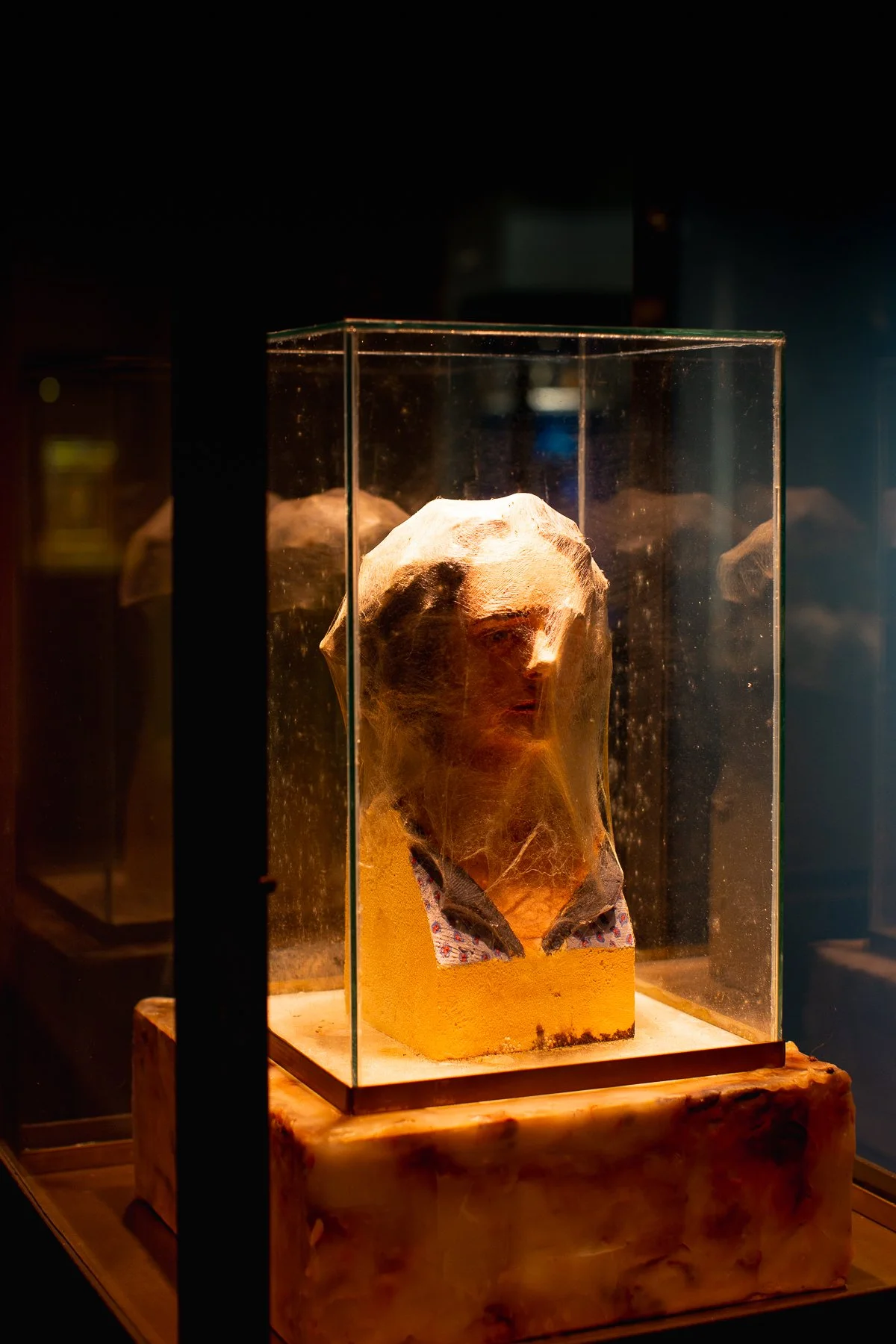
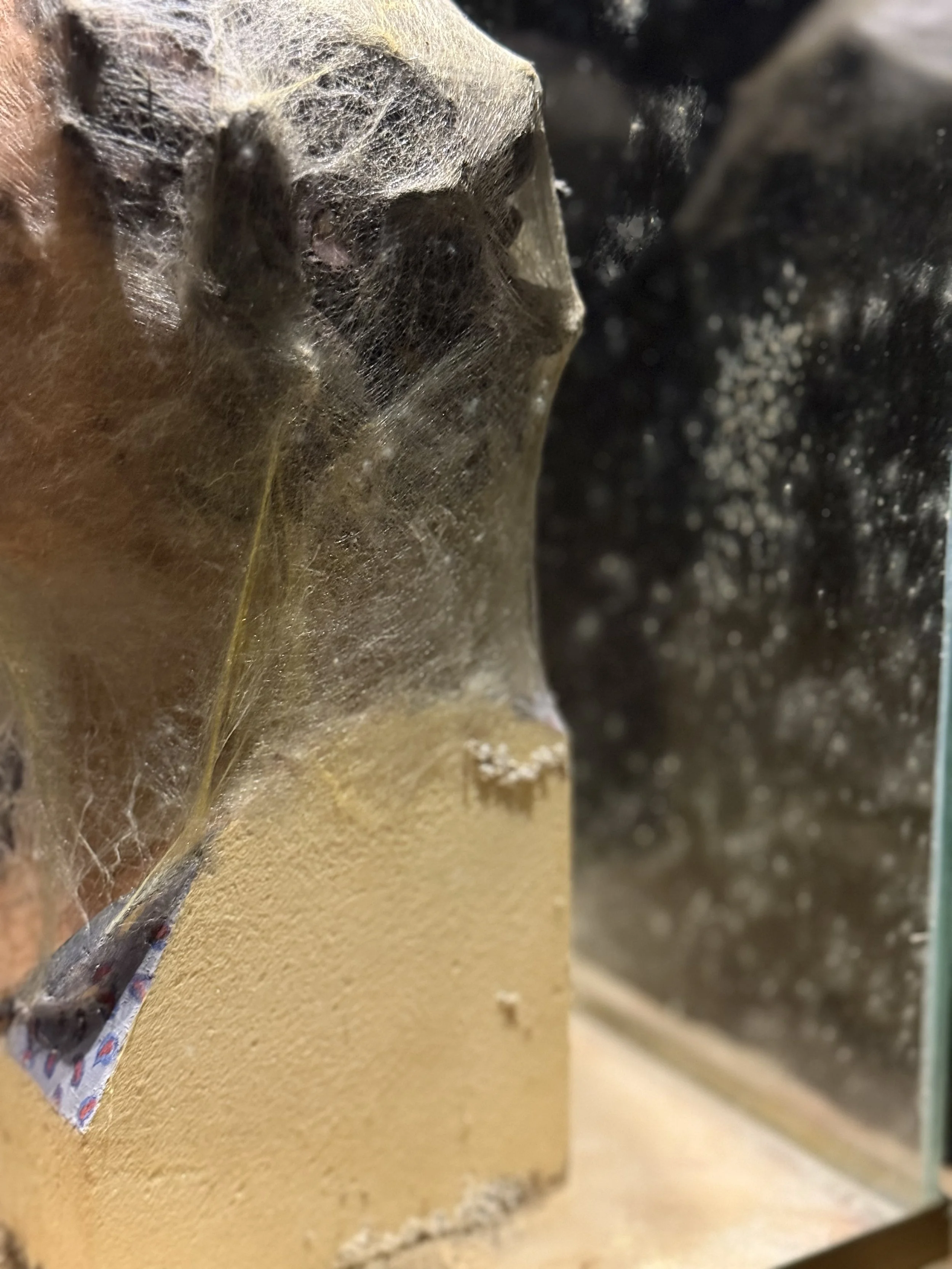
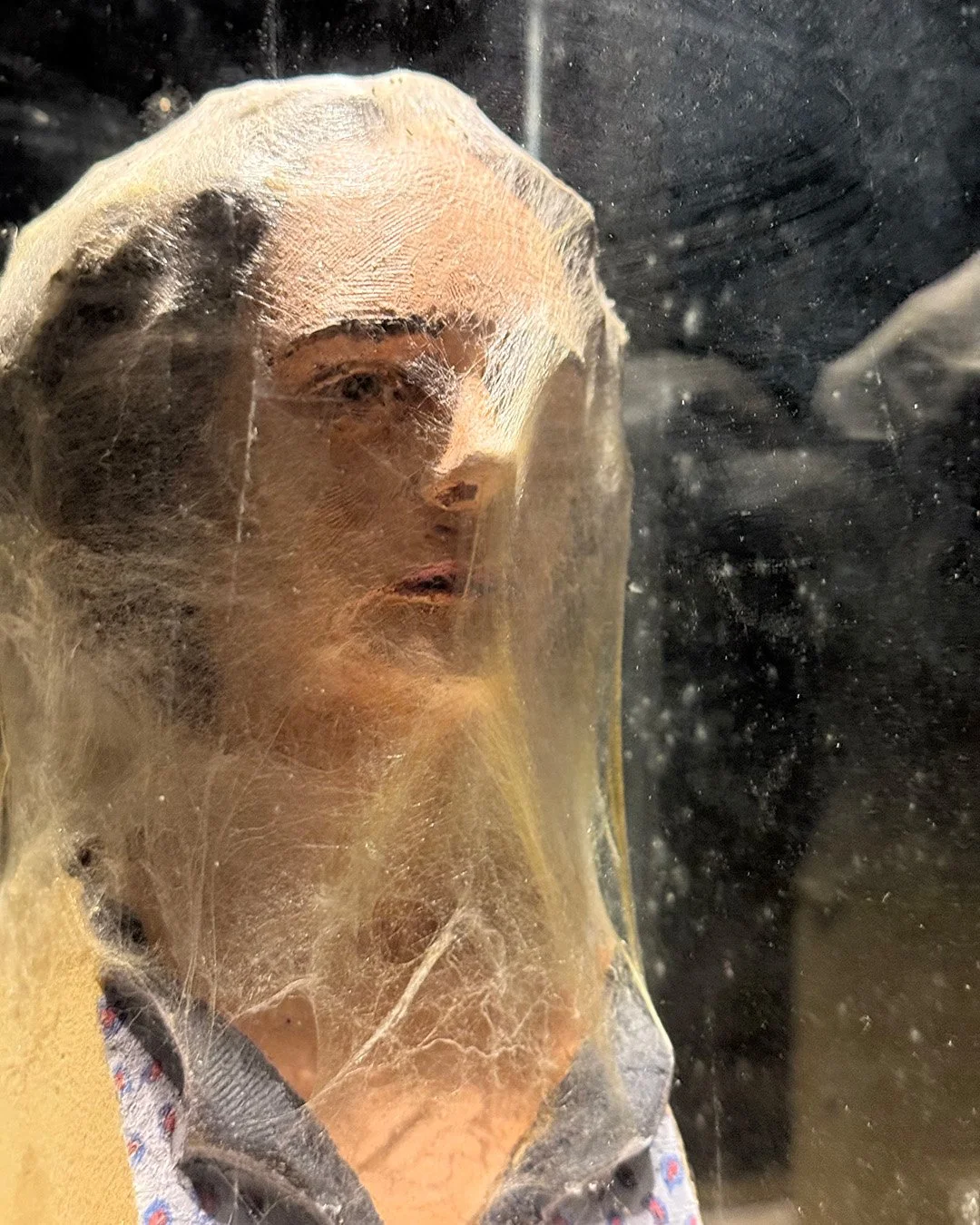
Memory Blocks: Veil examines memory as a material condition shaped through activity, residue, and differential rates of change. Silkworms are guided to spin silk directly onto a three-dimensional bust during a limited period of sustained activity. As silk accumulates across the contoured surface, the outline of the form is gradually altered through layering rather than direct intervention.
Once silkworm activity ceases, the temporal process slows markedly. What remains are traces of production in the form of uneven layers of silk, frass, eggs, and residual matter. Where silk accumulates more densely, the underlying painted surface becomes partially obscured, smoothing finer contours and reducing surface legibility. Where silk remains thinner, the form retains greater clarity. Visibility is therefore uneven, produced through differential accumulation rather than complete concealment.
Optically, the silk strands register as continuous lines that extend across the surface of the form. This produces a sense of visual extension that can be read as distance or temporal passage without physically separating viewer and object. A fixed internal light source causes the suspended form to reflect against the interior glass surfaces of the vitrine, further mediating perception and complicating visual access.
The work is housed within a concentric enclosure consisting of a smaller inner vitrine containing the bust and a larger outer vitrine that surrounds it. These repeated layers of containment regulate exposure and slow material decay, introducing delay as a structural condition of the work.
At the base of the outer vitrine, but separate from the inner enclosure, a rectangular wax block remains materially stable for the duration of the work. No visible accumulation, erosion, or structural change occurs on its surface. Positioned adjacent to the silk-covered form yet materially isolated from it, the wax block operates as a point of contrast, registering resistance to temporal inscription under different conditions of containment.
Through the combined conditions of organic activity and residue, optical mediation through layered enclosure, and material stability under adjacent containment, the work approaches memory as an uneven material registration. Memory emerges through selective accumulation, differential response, and trace rather than through uniform transformation.
Images: Steven Vawdrey and Sabine Bannard

Procedures of Memory
2024–2025
Vitrine, smoke, microcrystalline wax, hair, glass, wood, aluminium, and paint
205 × 102.5 × 102.5 cm
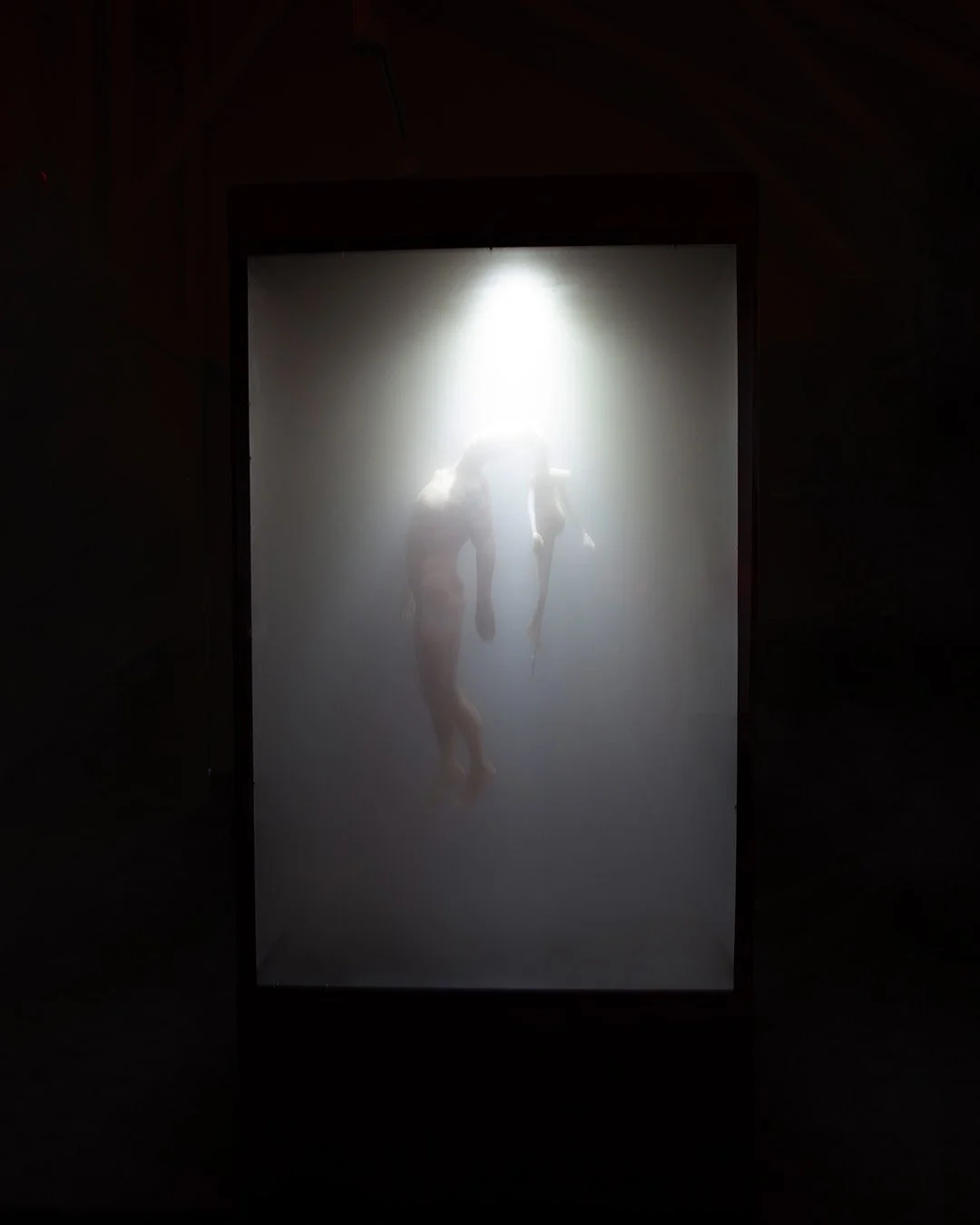
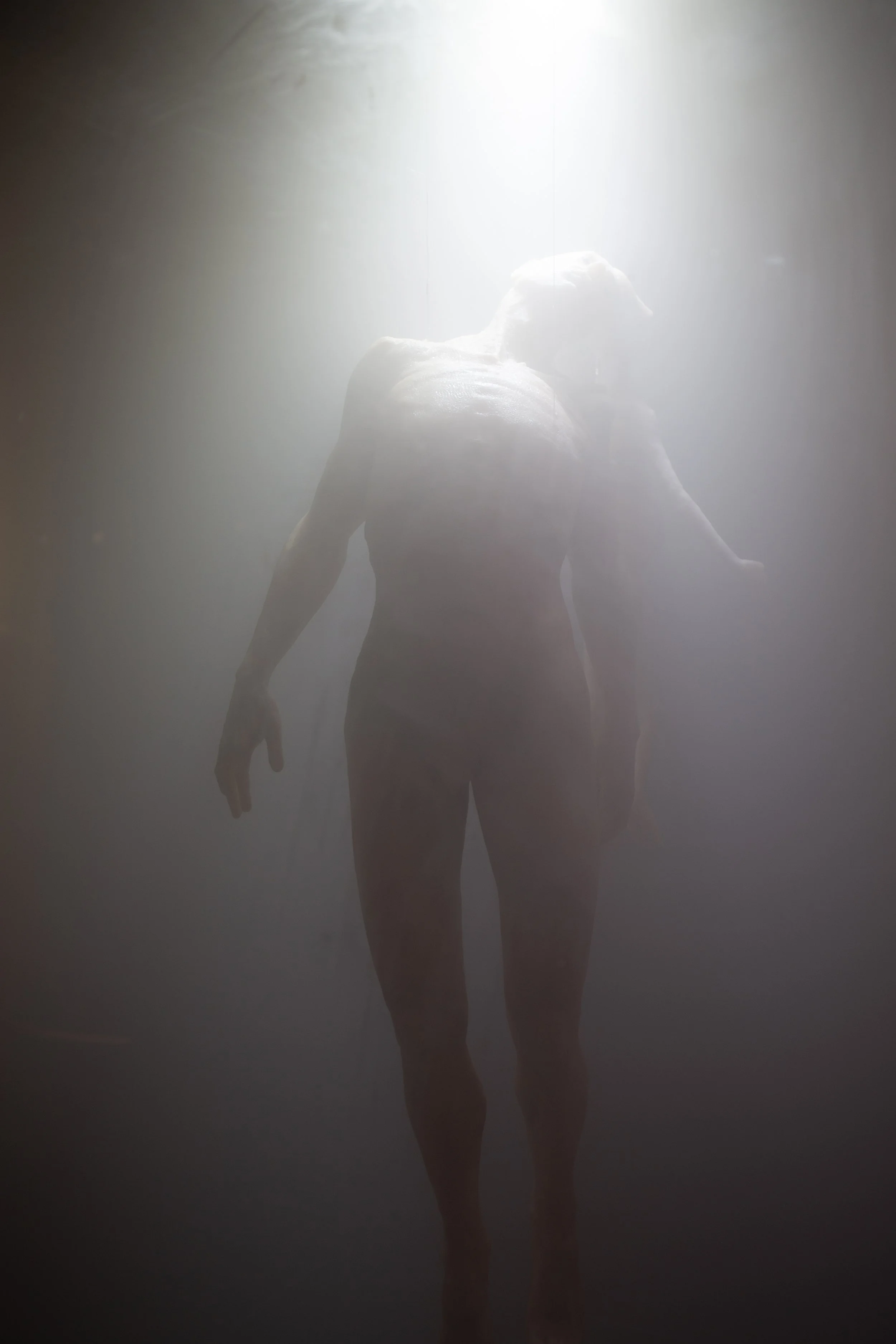
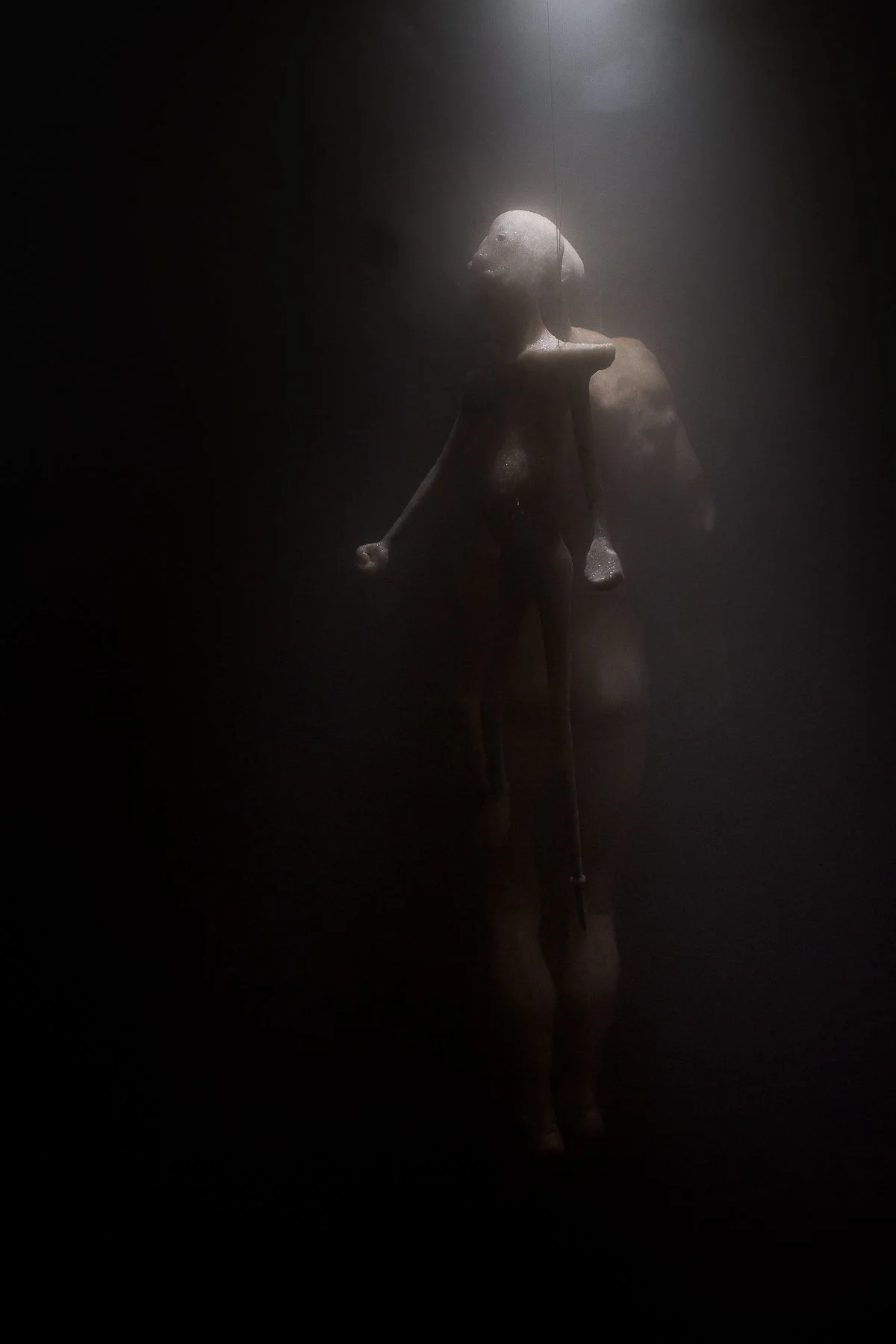
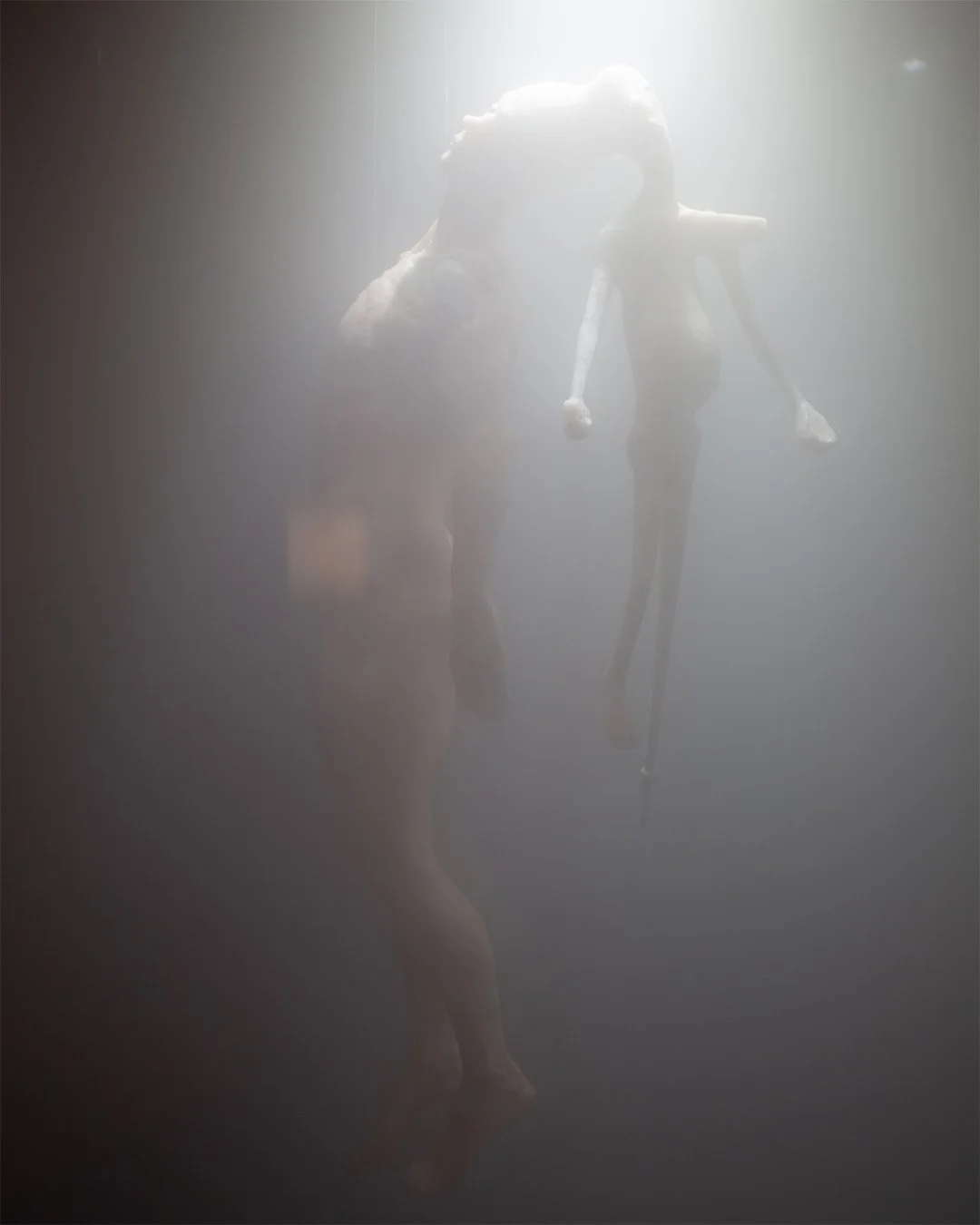
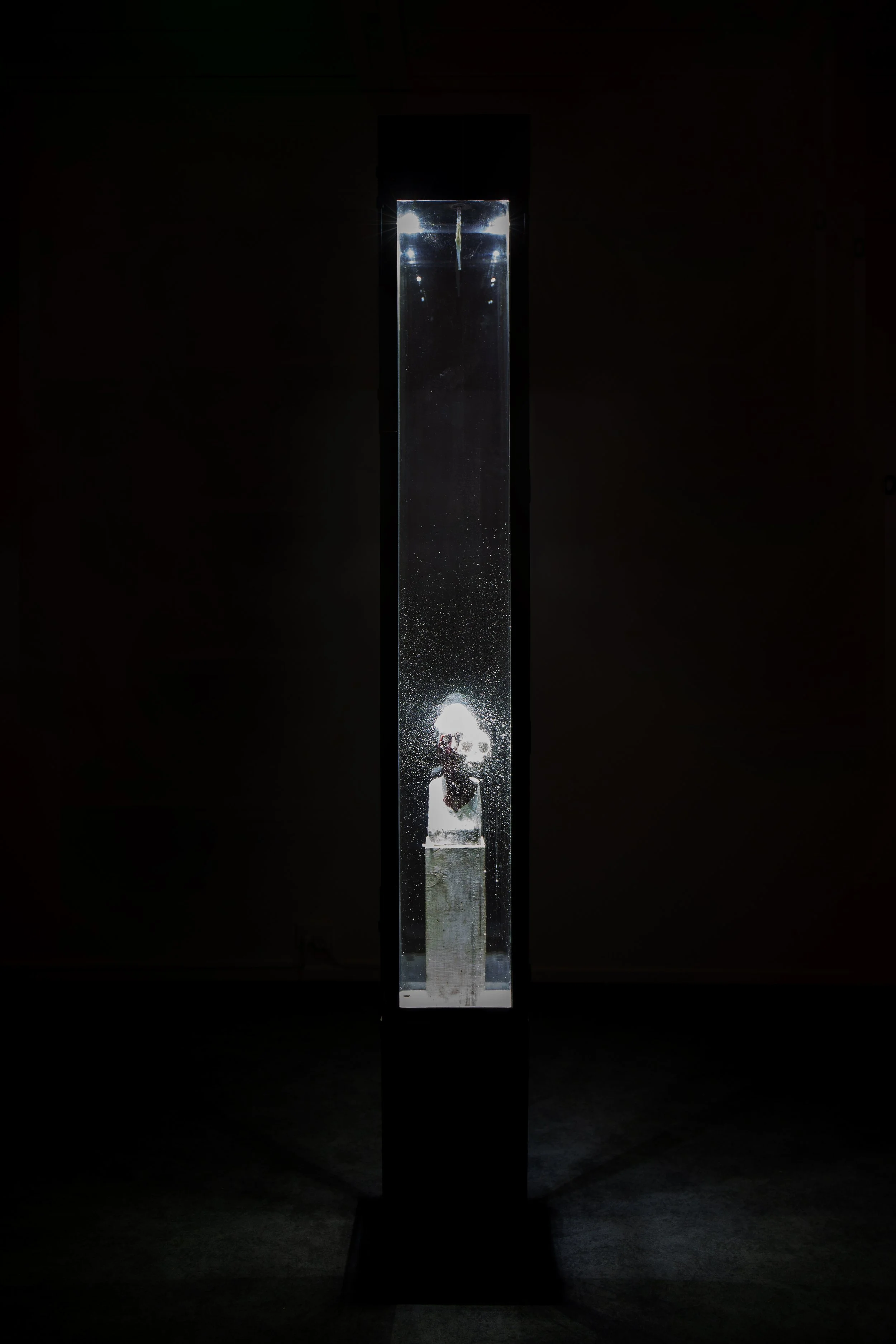
Procedures of Memory examines memory as a temporal and procedural condition enacted through repetition, obscuration, and trace. A dual sculptural figure cast in microcrystalline wax is suspended within a vitrine that functions as a controlled apparatus rather than a neutral display.
Concealed within the base of the vitrine, a smoke machine releases dense white smoke at regular intervals. Each activation is accompanied by an audible mechanical sound that punctuates the gallery space and marks time through repetition. Smoke enters through a single nozzle below the suspended figures and rapidly fills the enclosed volume.
A fixed internal light source mounted at the top of the vitrine remains constant throughout each cycle. As smoke density increases, light scattering and internal reflection intensify, brightening both the interior of the vitrine and the surrounding space. This reflective condition reduces optical penetration, making the wax figures increasingly difficult to discern despite unchanged illumination. At peak density, the shared whiteness of smoke and microcrystalline wax causes figure and atmosphere to visually merge, softening boundaries between object and environment.
As the smoke gradually disperses, the figures re-emerge incrementally rather than instantaneously. During this clearing phase, condensation forms along the interior glass surfaces and settles on the wax, producing droplets that register residue and trace. These deposits remain after the atmospheric event has passed, recording each cycle through accumulation rather than deformation.
The work operates through a repeated sequence of activation, obscuration, dispersal, and residue. Once the smoke fully clears, only material traces remain until the next activation restarts the process. Through this rhythmic recurrence, time becomes perceptible not as linear progression but as structured repetition. Memory is approached as something continually produced through cycles of disappearance, reappearance, and material trace.
Images: Steven Vawdrey and Sabine Bannard

The Scream
2023–2024
Vitrine, beeswax, graphite, acrylic, copper, crocodile clamps and electroplating bath
205 x 42 x 42cm
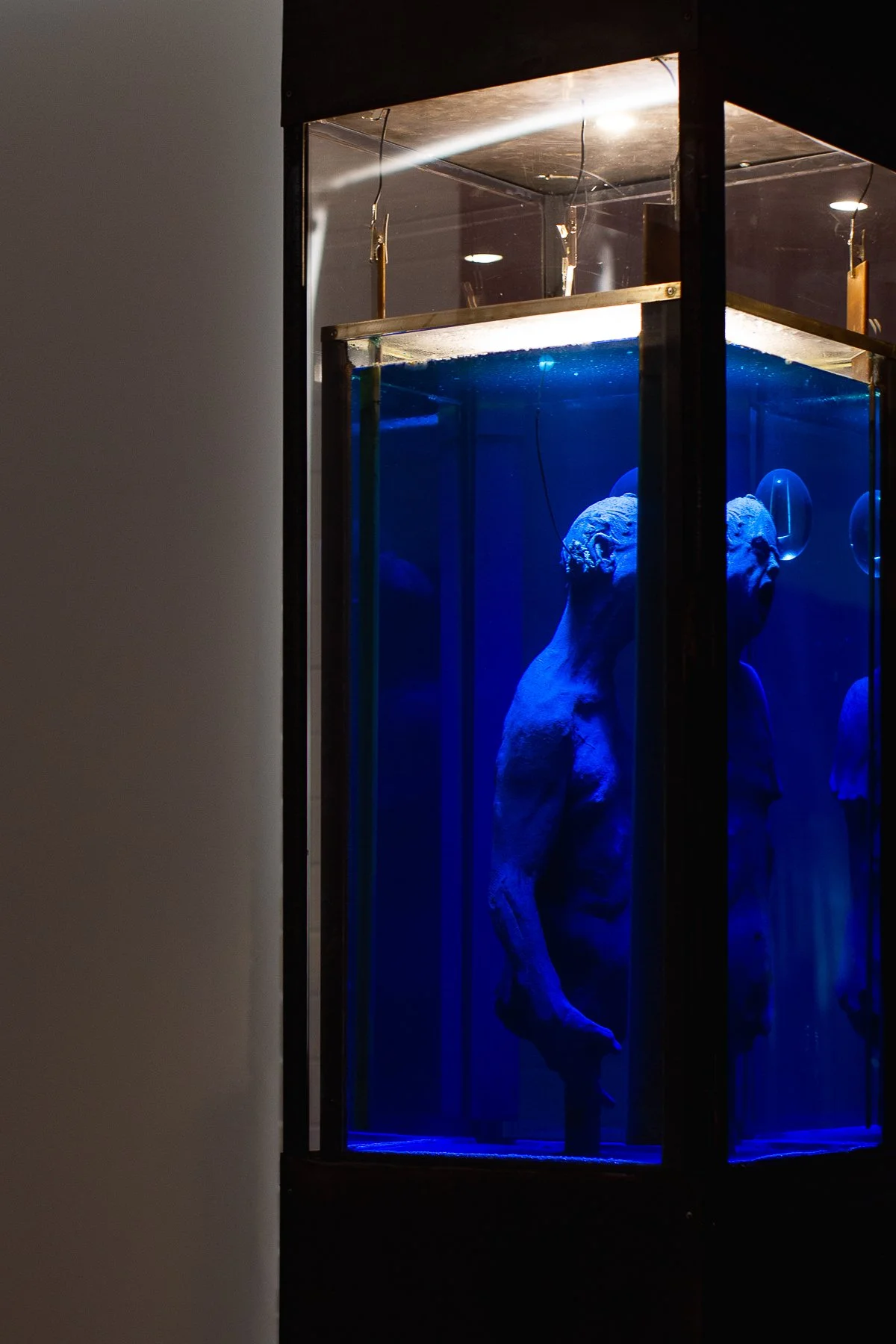
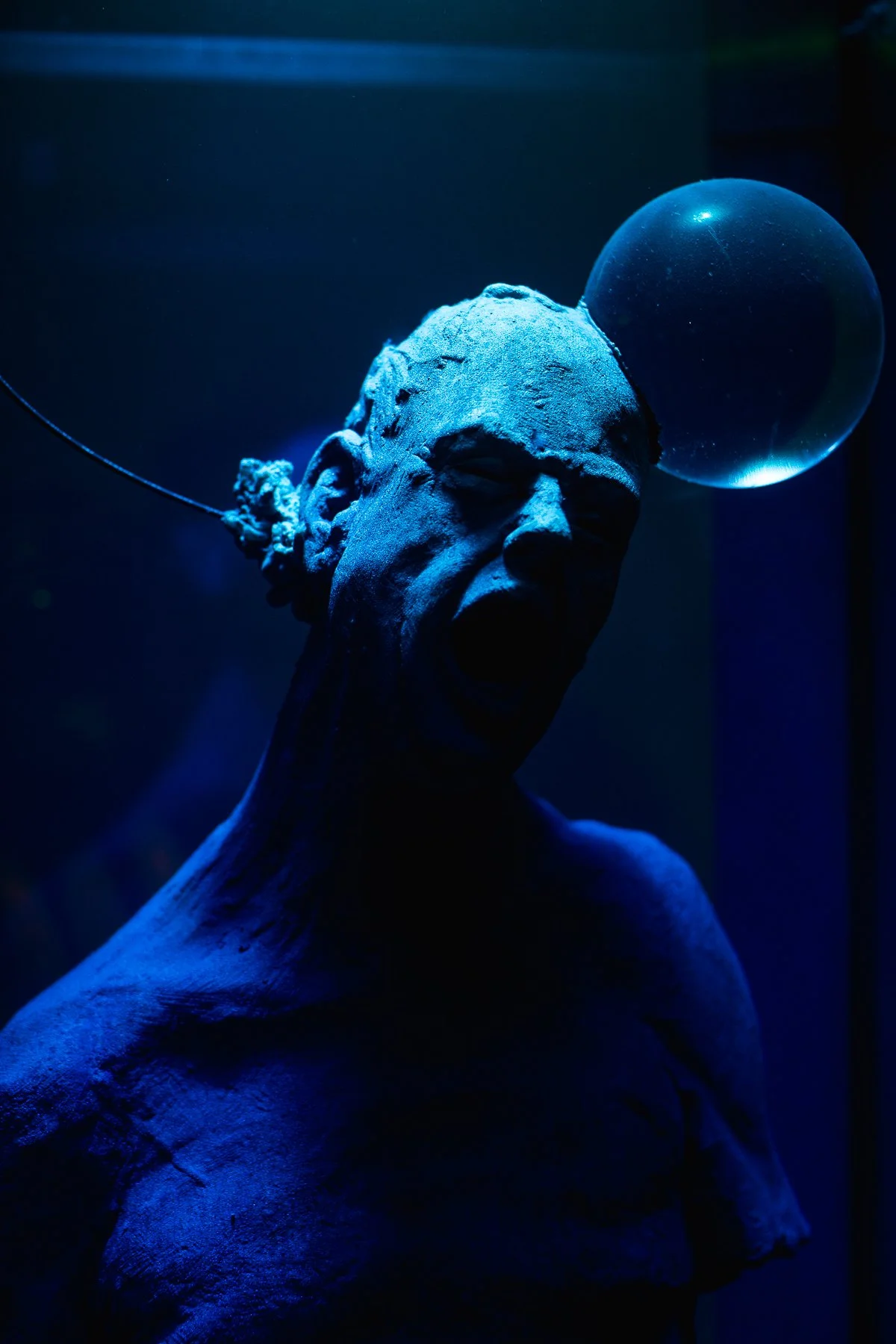
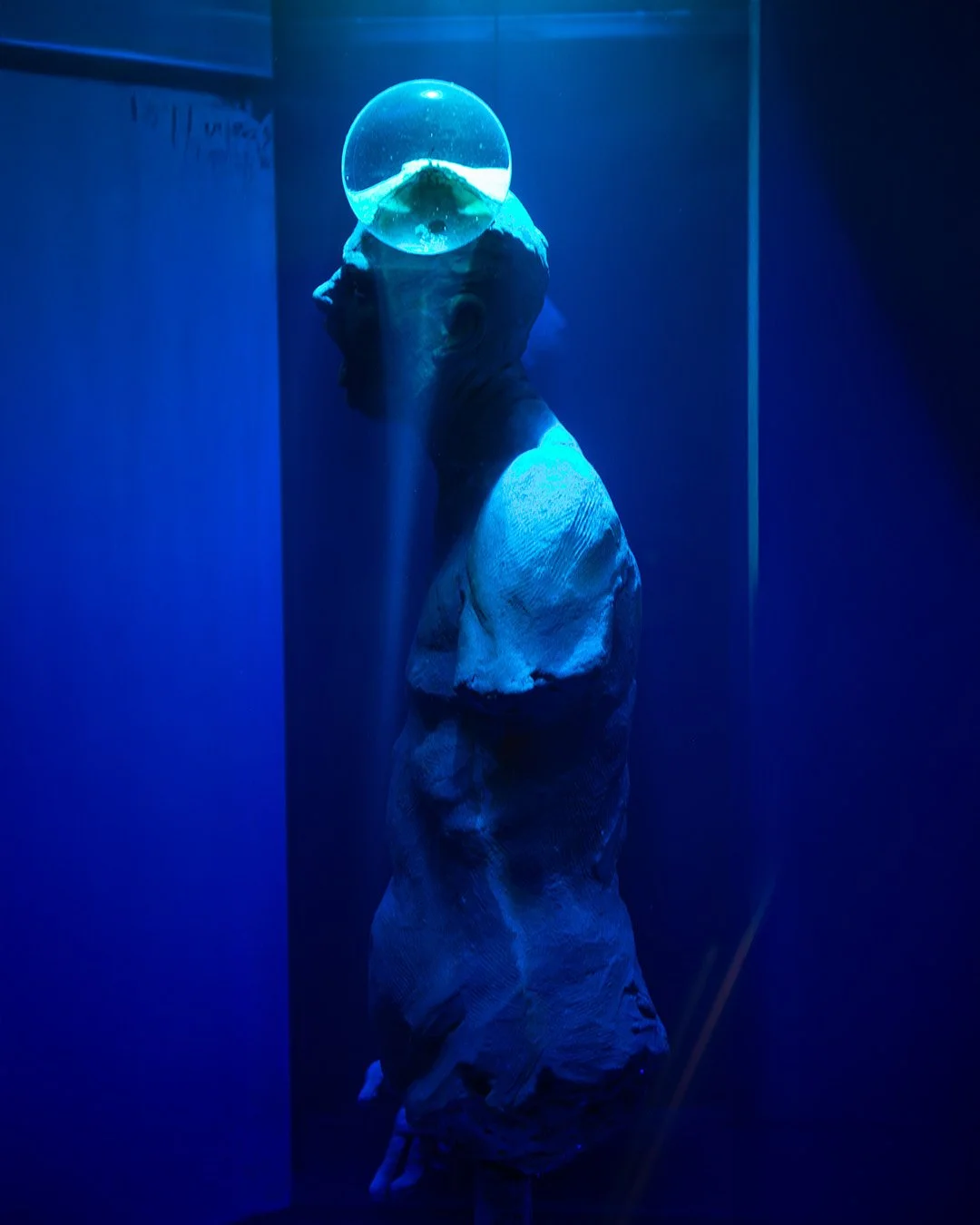
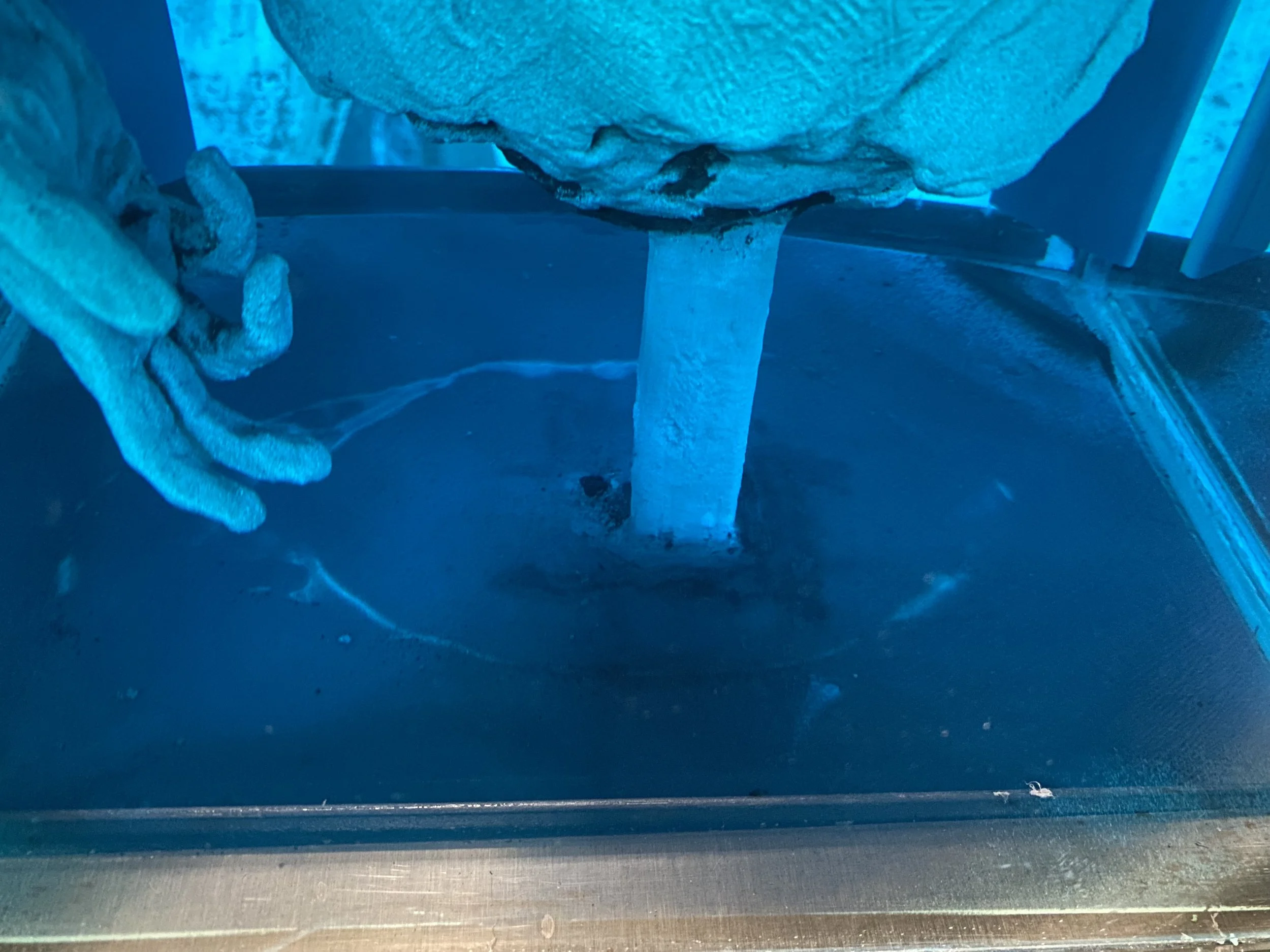
The Scream examines how sustained material accumulation alters form through duration and exposure. The work operates through electroplating as a continuous process in which copper gradually migrates onto a graphite-rich sculptural surface immersed in a copper-based solution.
During the early stages, deposition is subtle and requires close observation under the vitrine’s low internal lighting. Over approximately three weeks of continuous operation, copper accumulates unevenly across the surface. Fine details, particularly in areas of delicate modelling, become progressively rounded as successive layers build. Transformation occurs through incremental deposition rather than abrupt change. When viewed from certain angles, microcrystalline copper formations become visible, producing a restrained shimmer across the surface.
The optical density of the copper-rich solution further mediates perception of the submerged form. Within the same environment, a glass sphere remains free of deposition. Light passes unobstructed through this element and casts a defined beam into the bath. This establishes a material and optical contrast between accumulation and transparency, distortion and clarity.
Secondary effects are integral to the work’s operation. Copper residue settles at the base of the vitrine and partially echoes the contours of the submerged sculpture. Prolonged chemical exposure also affects the vitrine itself, extending the process beyond the sculptural form. Through these combined conditions, time operates as an active material force, shaping form, visibility, and containment through sustained exposure and gradual transformation.
Images: Sabine Bannard

Blouapie /ˈbləʊ.ˌɑː.pi/
2023-2025
Vitrine, water, salt, Vervet monkey skull, beeswax, pin, button, plaster and cotton.
Dimension: 205 x 26 x 26cm
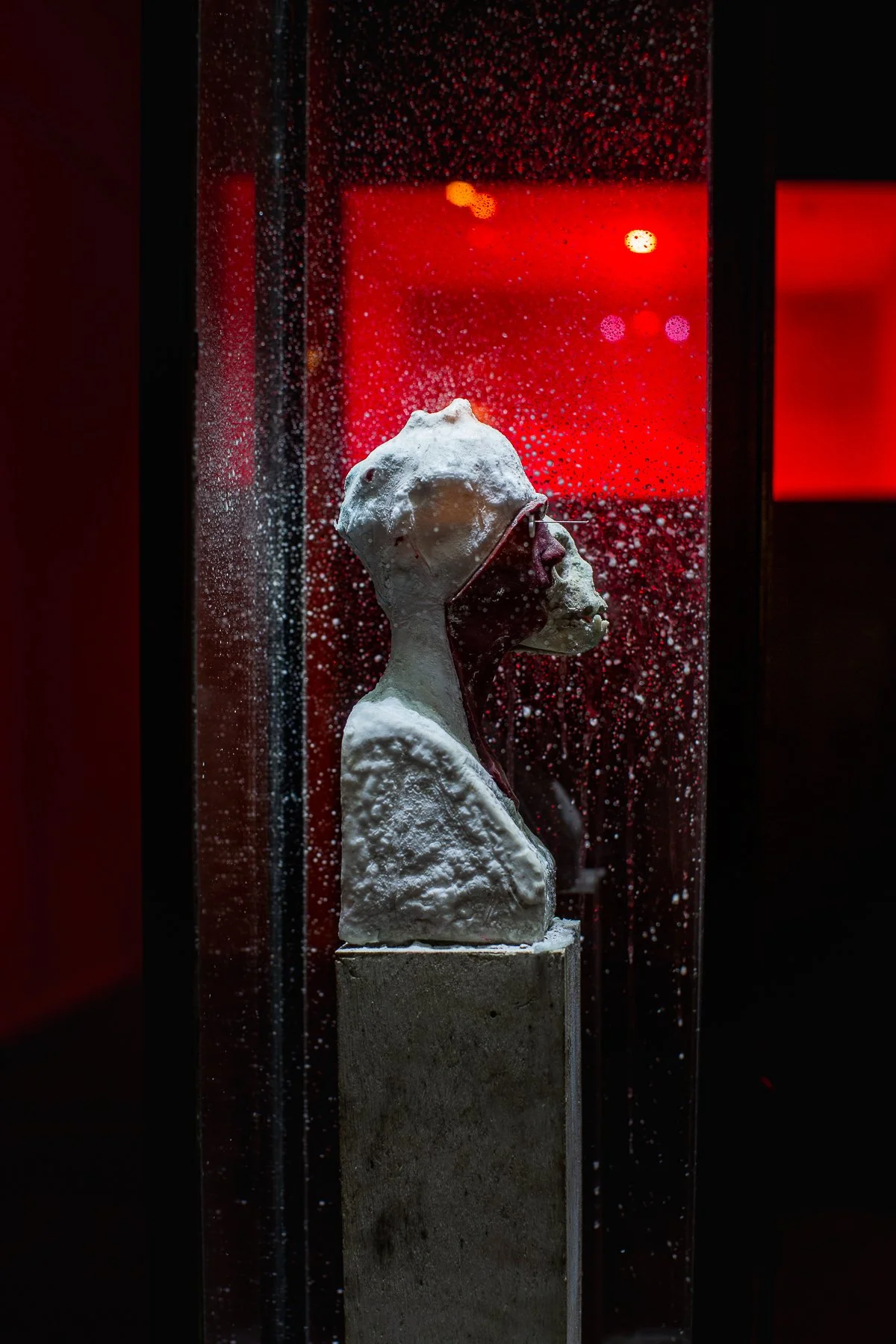
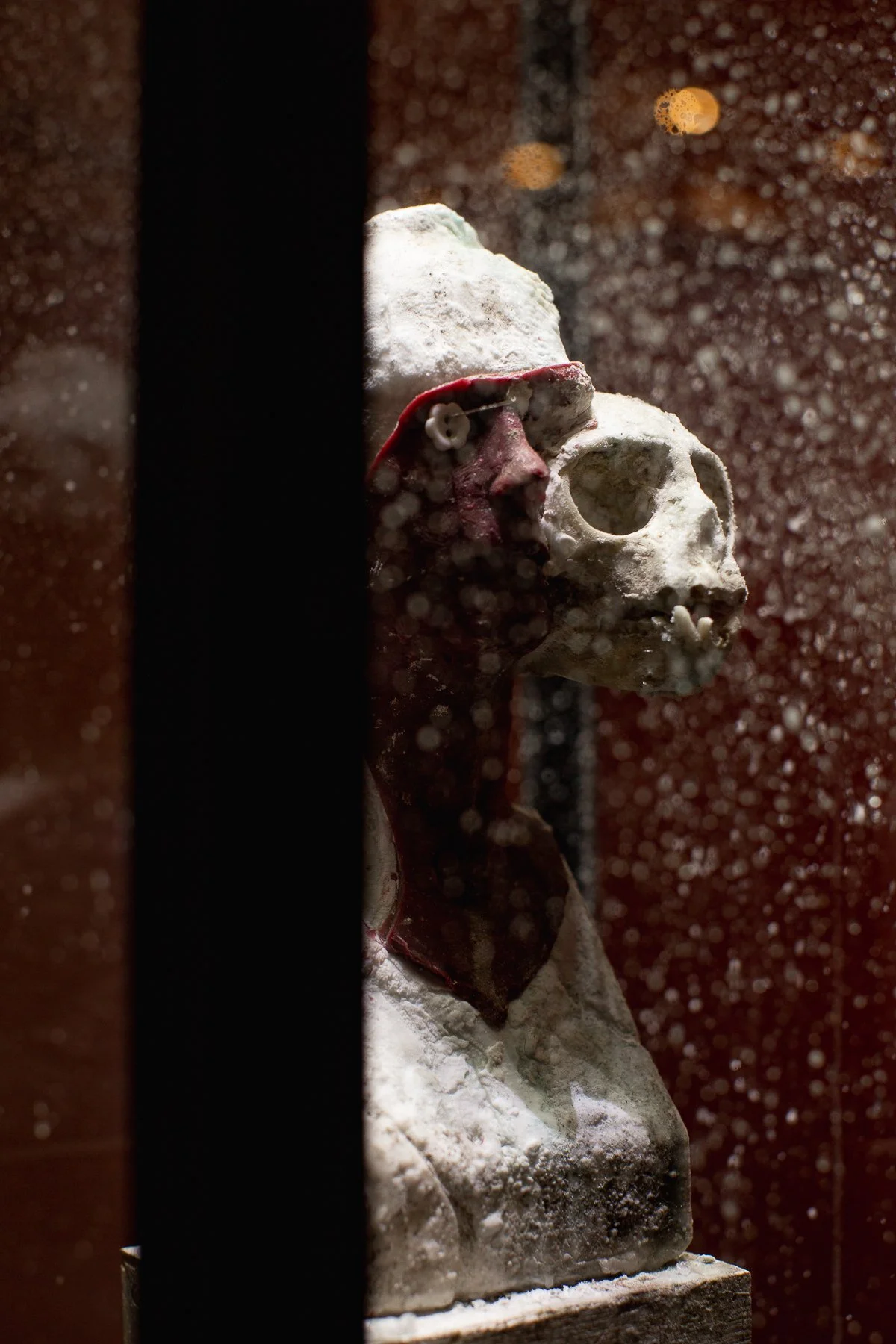
Blouapie examines memory as a material process shaped through duration, repetition, and differential response. Salt-saturated water drips continuously onto wax, plaster, and bone, producing uneven material change through sustained exposure over time.
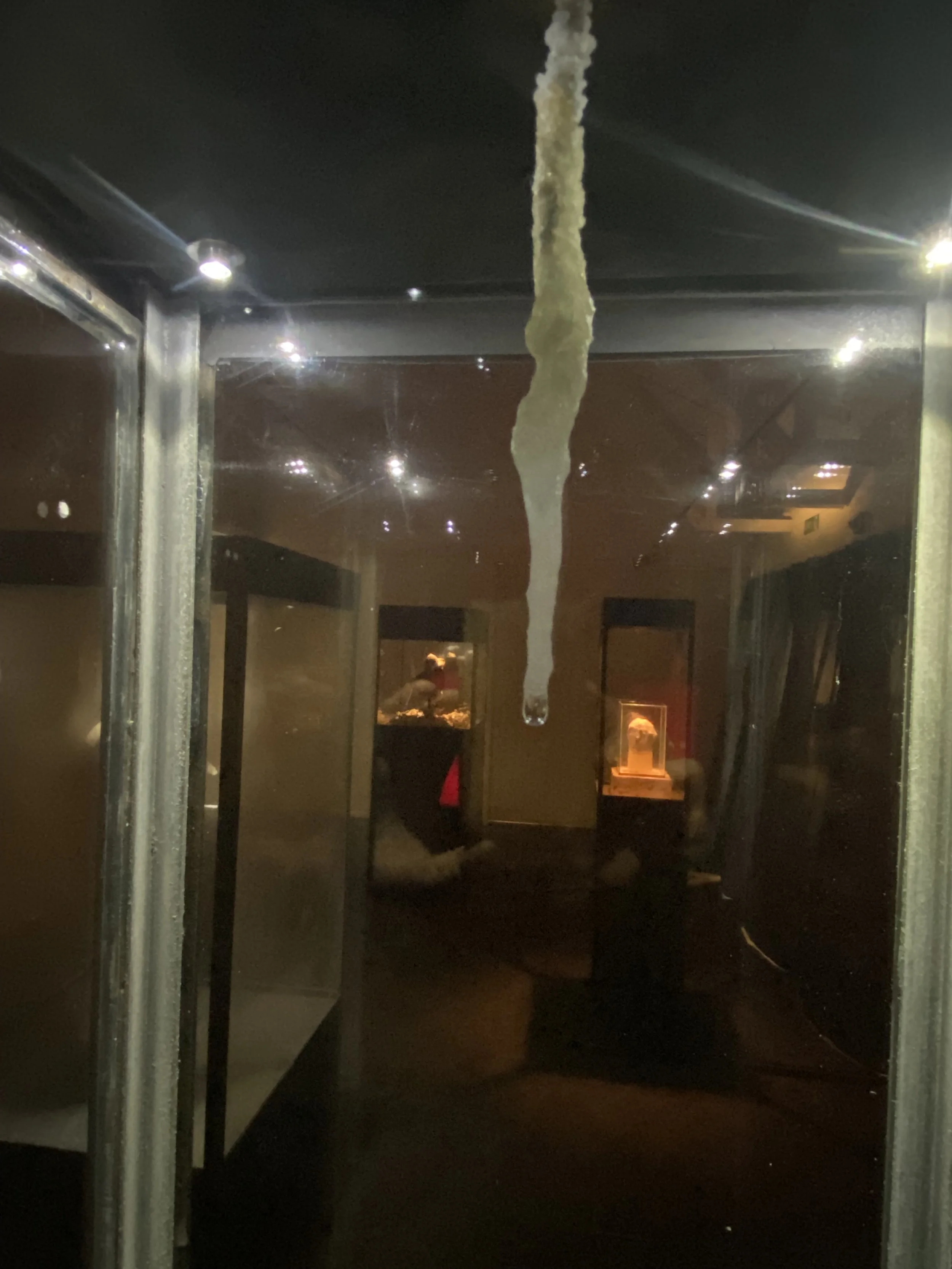
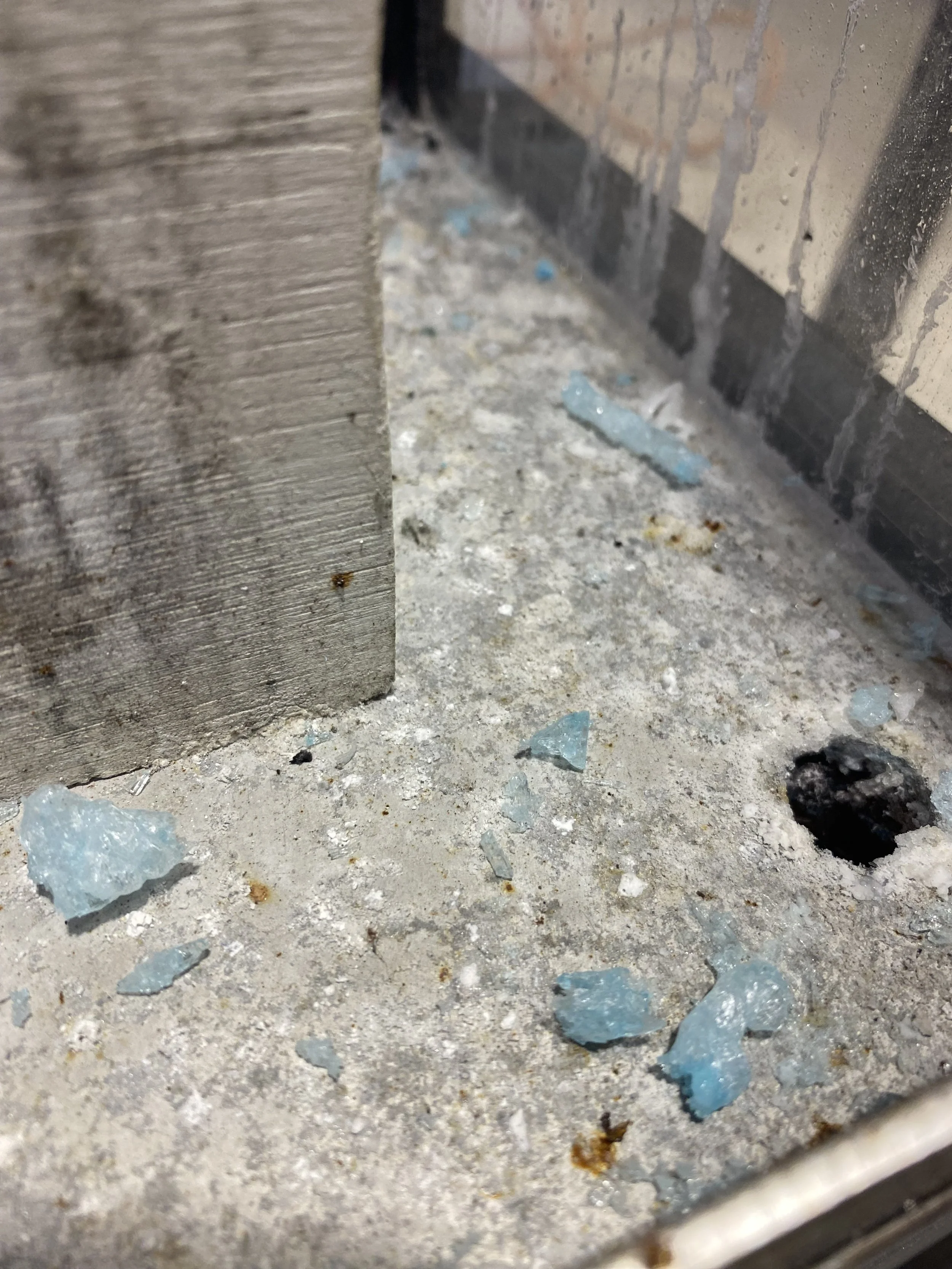
The solution is delivered through a plaited cotton rope that functions as a regulating element within the system. As salt accumulates along the fibres, crystalline growth alters both the rope’s length and permeability. Ambient temperature directly influences this process. In warmer conditions, crystalline structures shorten and fracture, shedding residue that falls to the base of the vitrine. In cooler conditions, crystalline growth extends, increasing the rope’s length.
These changes modulate the tempo of the drip. As salt builds along the rope, flow slows and becomes irregular, introducing variation into an otherwise continuous process. The rope therefore operates as a temporal regulator, linking environmental conditions to the rate and rhythm of material exposure.
Under identical conditions, materials respond unevenly. Wax remains structurally stable while accumulating surface residue. Plaster undergoes localised erosion alongside areas of salt accretion. Bone retains its form, registering exposure primarily through microcrystalline growth. Salt and water residue also accumulate on the interior glass surfaces of the vitrine, partially obscuring visibility and introducing mediated perception as part of the work’s operation.
Through these combined conditions of flow, accumulation, erosion, and trace, memory is approached not as fixed preservation but as an evolving condition shaped by exposure, resistance, and environmental variation over time.
Images: Steven Vawdrey and Sabine Bannard

Red
2023–2024
Vitrine, pigment, resin and compressed air
205 x 101.5 x 101.5cm
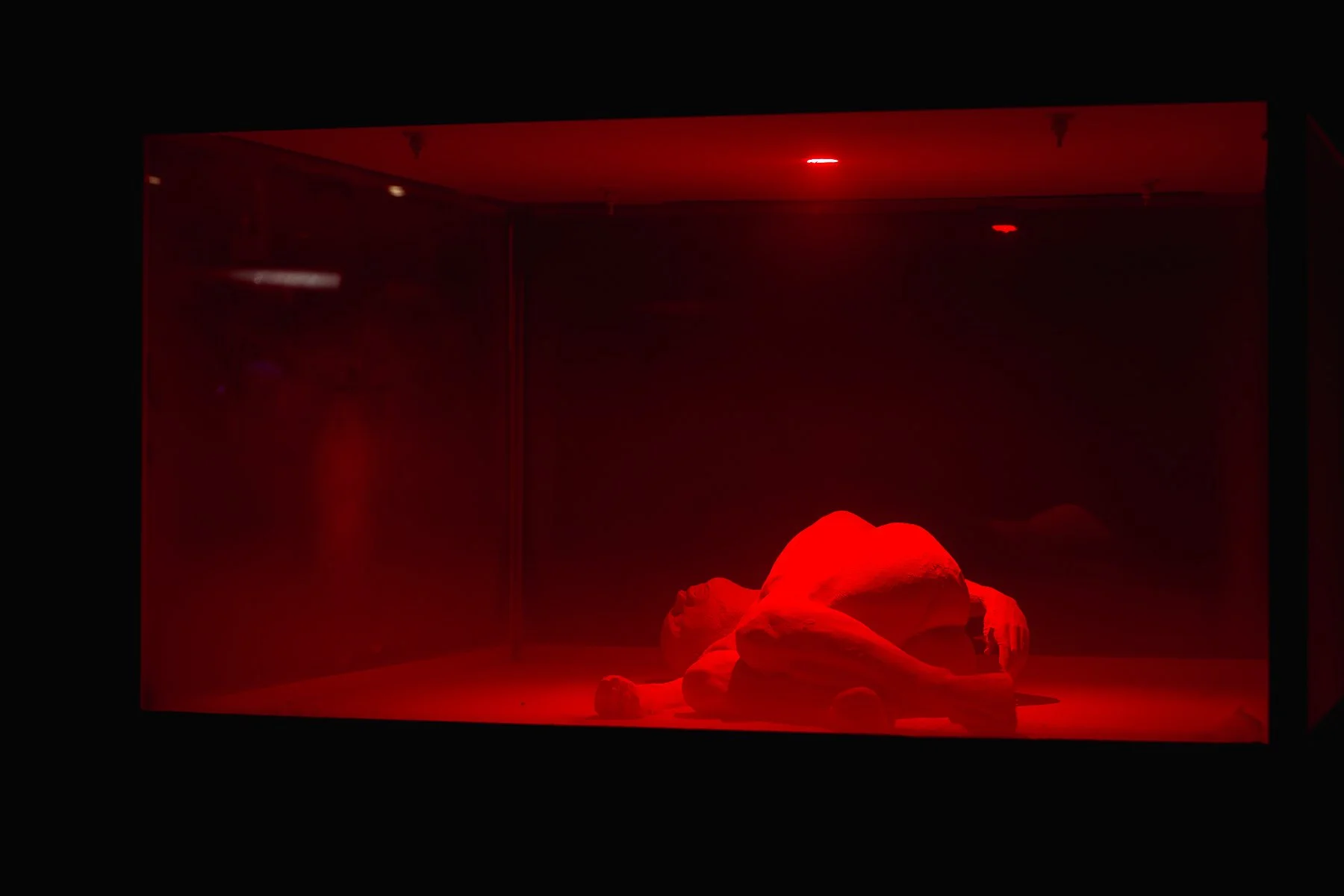
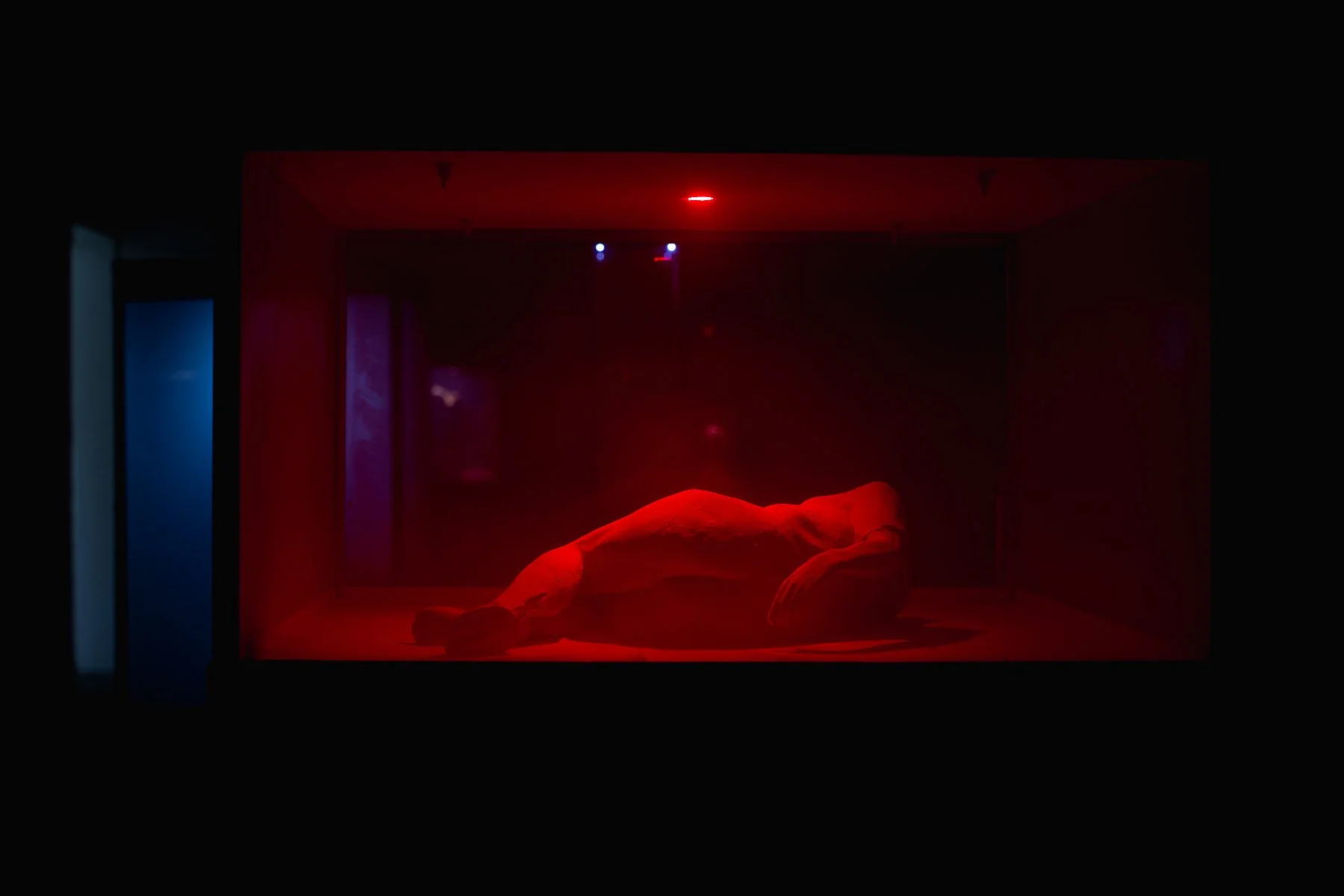
Red examines memory as a condition shaped through disturbance, residue, and gradual stabilisation within a driven system. The work operates through a mechanically induced process activated by a concealed air compressor programmed on a timer.
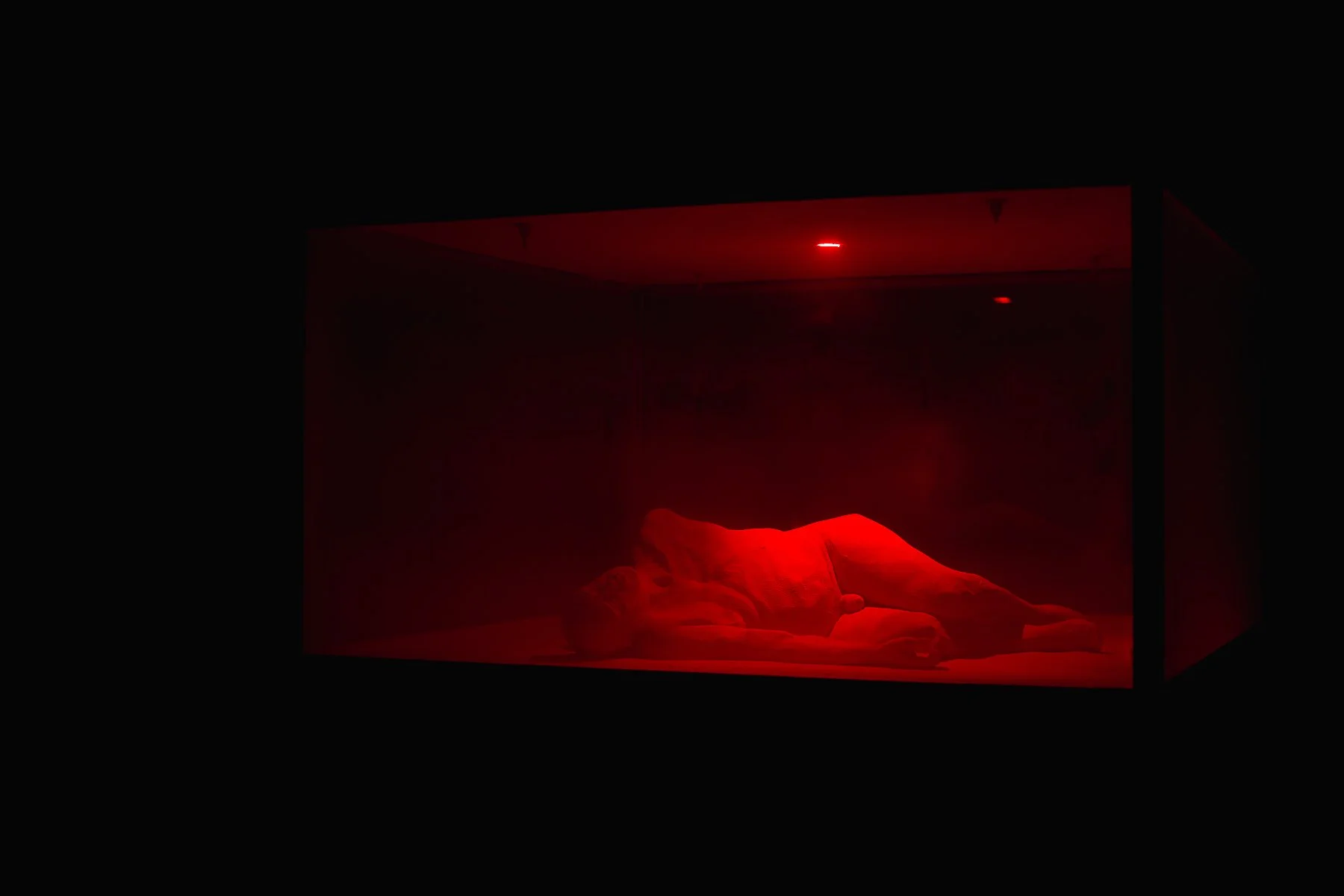
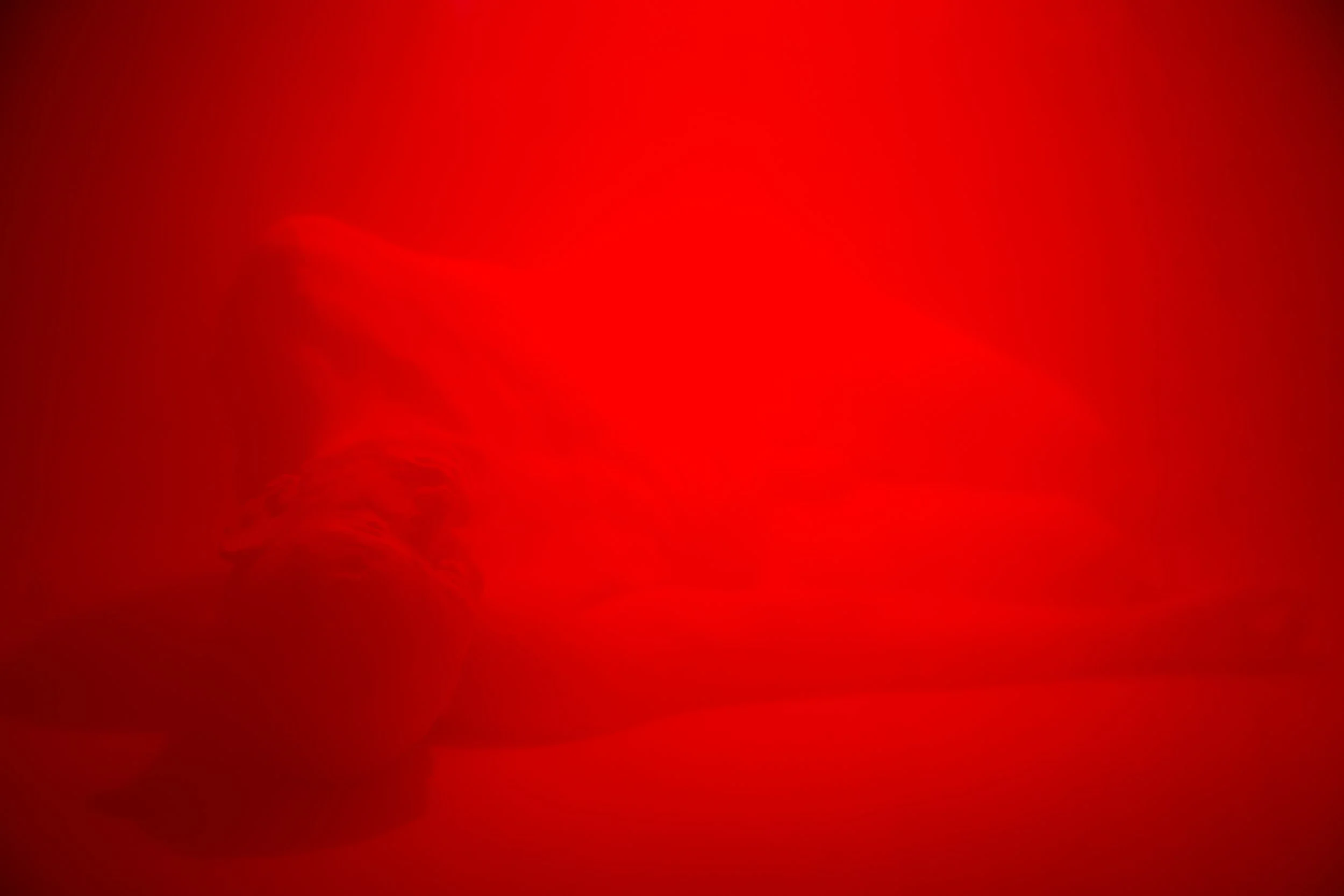
Dry red pigment is initially settled across the base of the vitrine alongside a reclining sculptural figure painted in the same red hue. At regular intervals, compressed air is released through jets concealed in the ceiling of the enclosure and directed downward toward the base. Each activation forces the pigment into suspension, forming a dense red cloud that temporarily obscures the figure and dissolves clear spatial definition within the vitrine.
As air pressure subsides, the pigment settles back into a sedimentary state. Although the overall configuration may appear similar from cycle to cycle, the redistribution is never identical. Over repeated activations across an extended period, pigment gradually migrates away from the most direct air streams and accumulates in areas less affected by turbulence. These zones become increasingly stable, while other areas continue to register disturbance.
The sculptural form itself remains structurally stable throughout this process. As pigment repeatedly settles onto the surface, fine details of the figure become progressively softened. Pigment remains visible as residue while simultaneously reducing the sharpness of the underlying form. Partial concealment occurs through accumulation rather than complete obscuration.
Fine red pigment also accumulates on the interior glass surfaces of the vitrine, filtering visibility without fully blocking access to the interior. As the system stabilises, both the pigment and the figure become visually less disrupted, registering a gradual shift from active disturbance toward relative equilibrium.
Visibility within the work is not fixed but contingent. It is produced through repeated cycles of obscuration and reappearance, allowing memory to register as a visual condition rather than as a stable image. The periodic sound of the air compressor punctuates the gallery space and marks time through repetition. Change does not progress linearly but unfolds through cycles of suspension and settlement, positioning memory as a condition shaped by repeated activation, residue, and uneven stabilisation over time.
Images: Sabine Bannard and Steven Vawdrey
Memory Blocks: Ma/Mother
2025
Vitrine, acrylic, mineral oil and beeswax
205 x 55 x 55cm
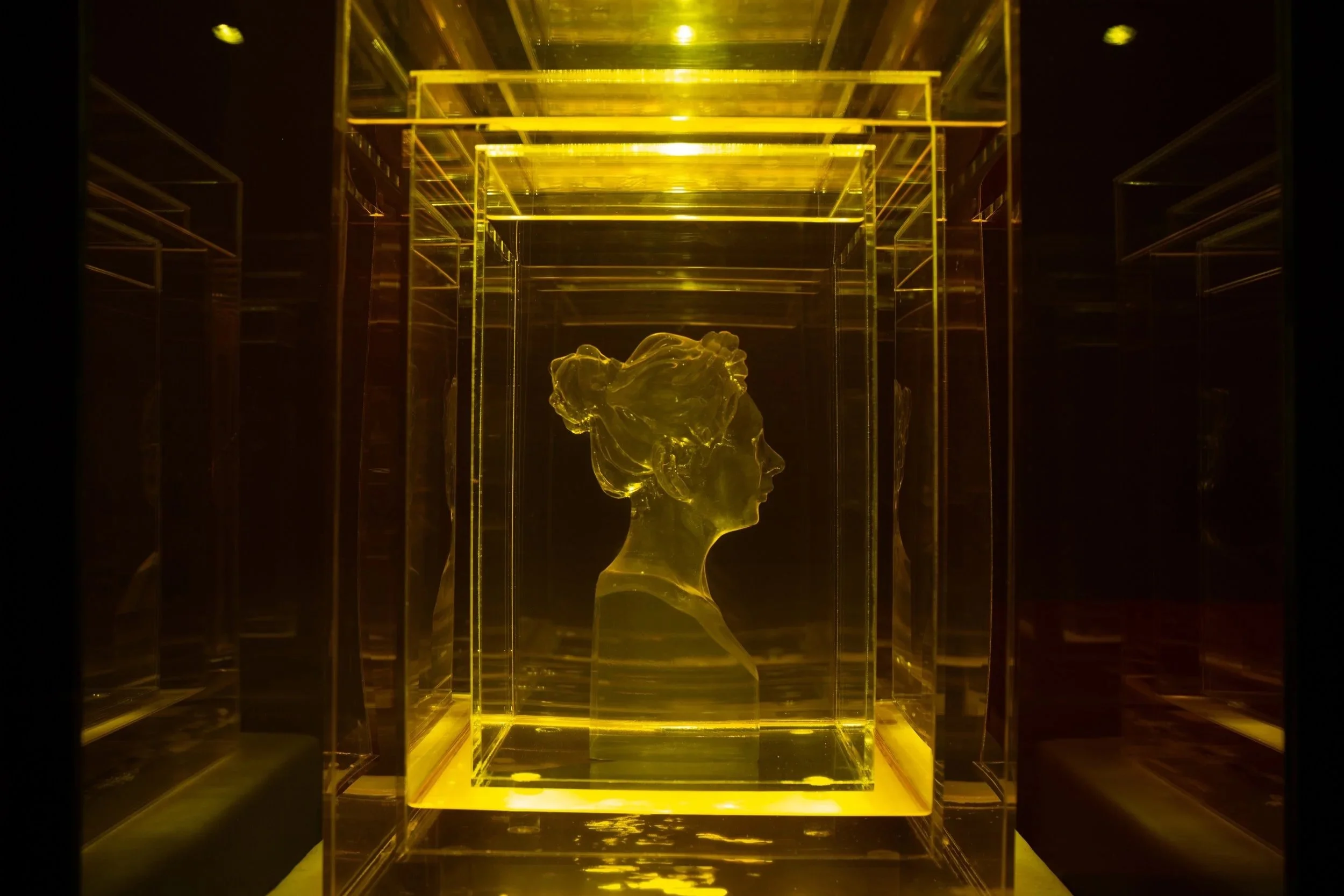
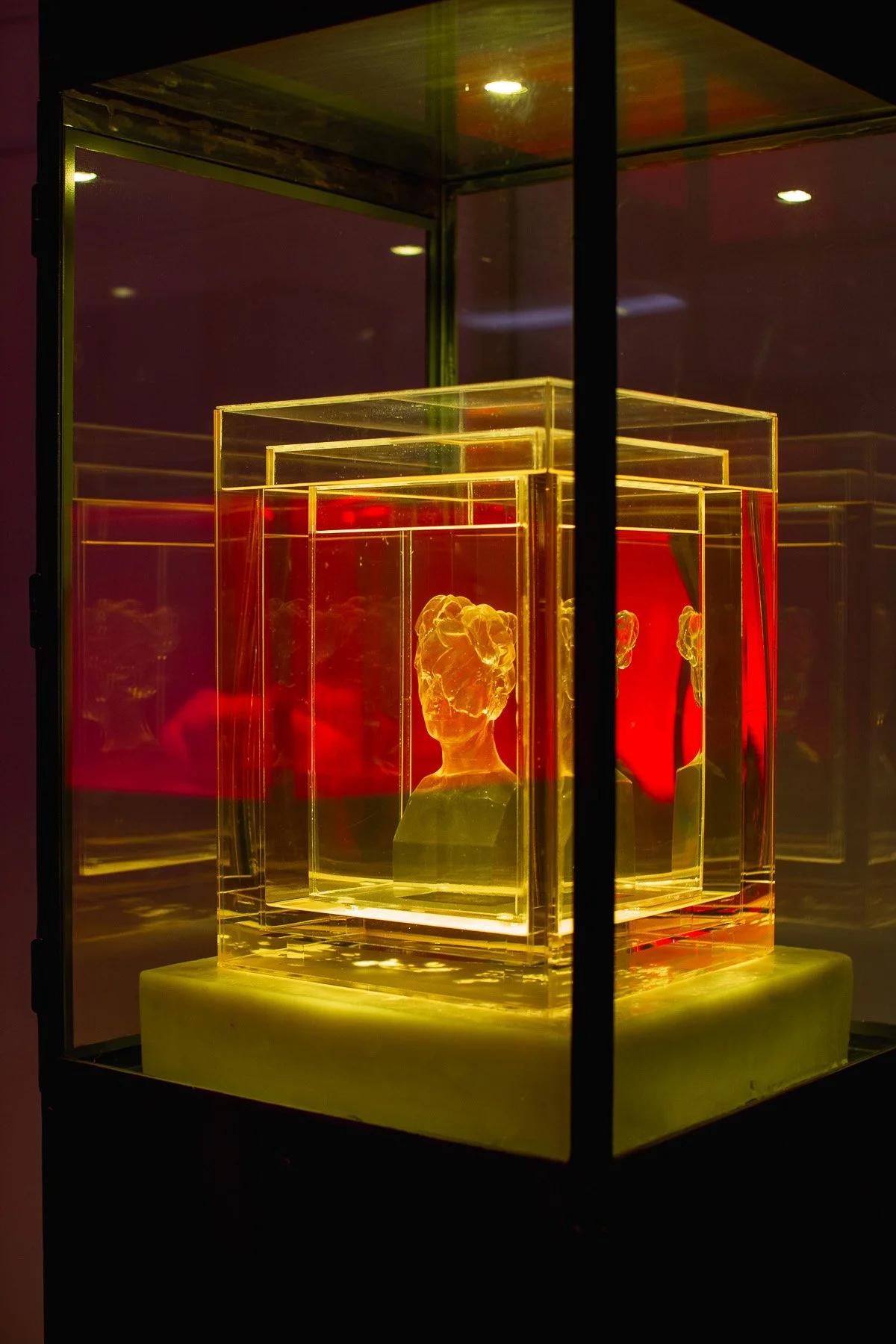
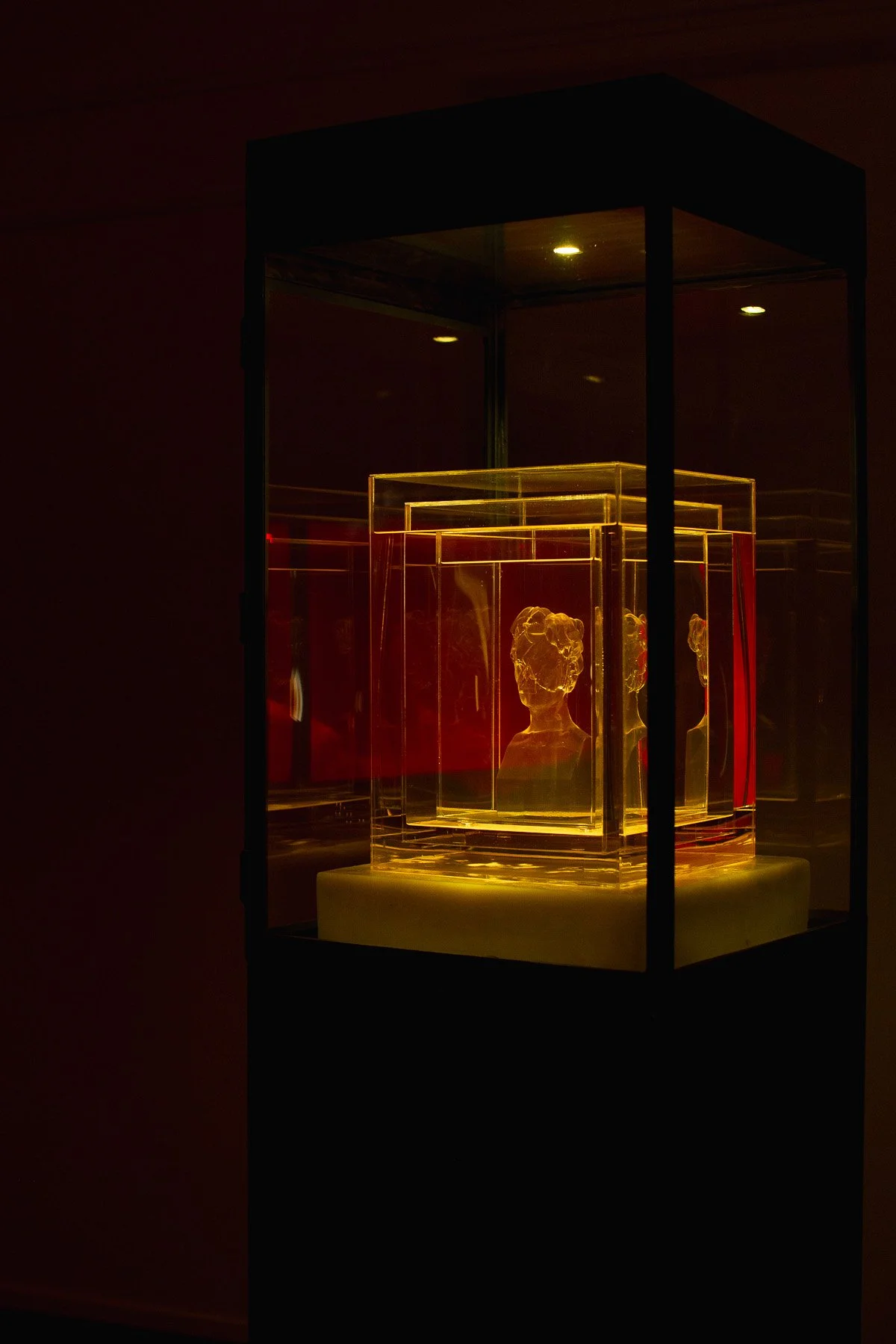
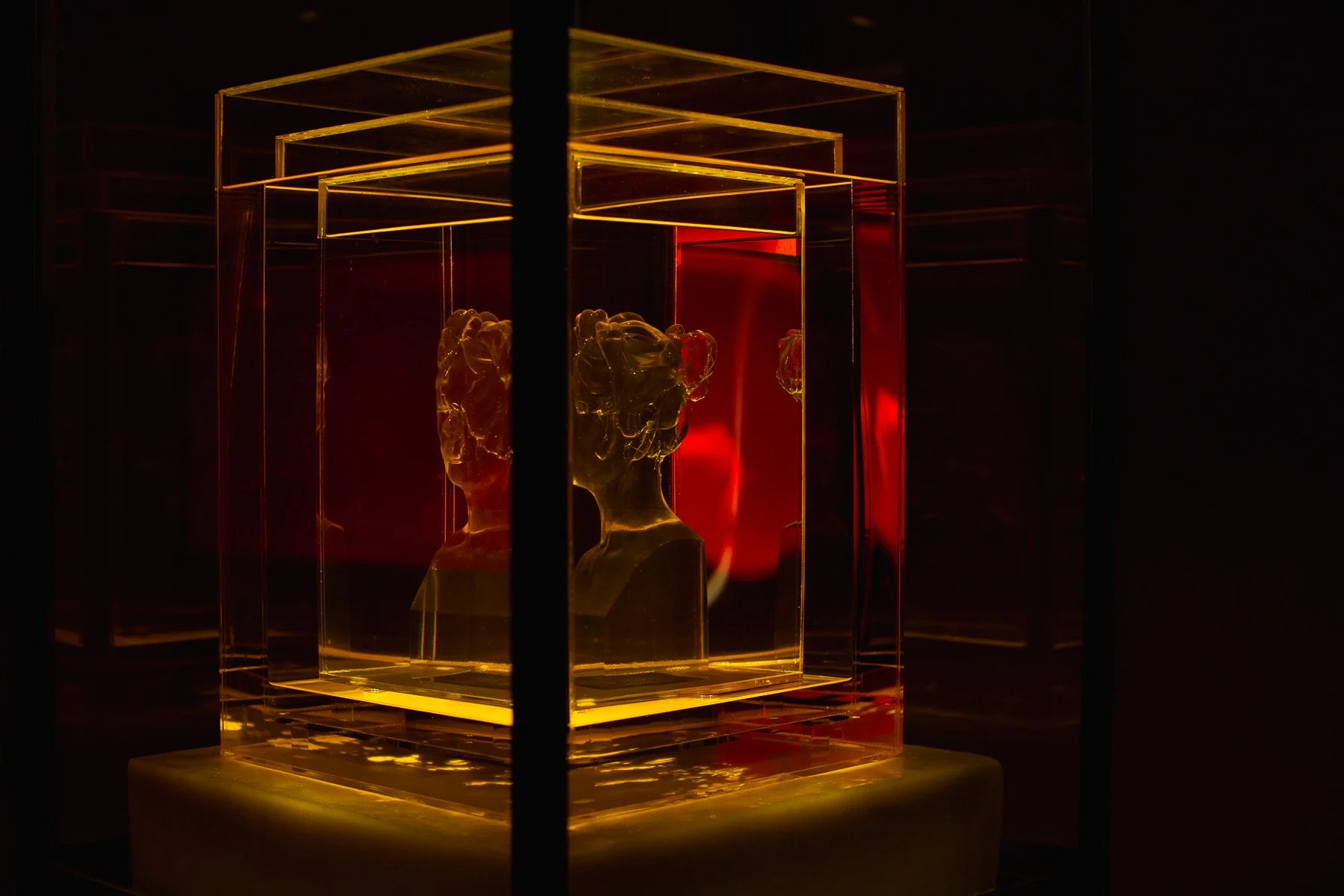
Memory Blocks: Ma / Mother examines memory through conditions of transparency, reflection, and optical mediation rather than through material transformation. A transparent resin cast is positioned within a sequence of four concentric vitrines, forming a layered system in which visibility is repeatedly refracted rather than altered through physical change.
At the centre of the structure, the resin form is suspended within oil. Although oil is present within the three inner vitrines, only the innermost enclosure brings it into direct contact with the resin. No visible material change occurs at this interface. Both materials remain structurally stable for the duration of the work. The resin carries a slight yellow tint introduced during curing, which is closely matched to the colouration of the oil. This chromatic alignment reduces edge contrast and causes portions of the transparent form to appear softened, blurred, or intermittently absent.
Under low light conditions, this effect intensifies. Depending on the angle of observation, the form may register as faint, doubled, or partially dissolved into surrounding reflections. Rather than asserting solid presence, the form produces a sense of spatial void. The multiple glass surfaces of the vitrines generate repeated reflections and refractions, causing the image of the form to multiply, shift, and overlap across planes of containment.
Beneath the inner vitrines, a rectangular slab of yellow wax remains materially stable and undisturbed. Like the resin and oil, it does not register temporal change. Variation arises instead through the movement of the viewer. As the observer shifts position, angles of reflection realign, bringing certain images into visibility while others recede or disappear.
Through these combined conditions of material stability, chromatic alignment, layered containment, and viewer-dependent reflection, the work approaches memory as a visual condition shaped by mediation rather than inscription. What changes is not the object itself but its legibility. Memory is produced repeatedly through distance, alignment, and the act of looking rather than through accumulation or loss.
Images: Steven Vawdrey and Sabine Bannard

The Secret
2024
Bronze, ceramic shell
205 x 81 x 81cm
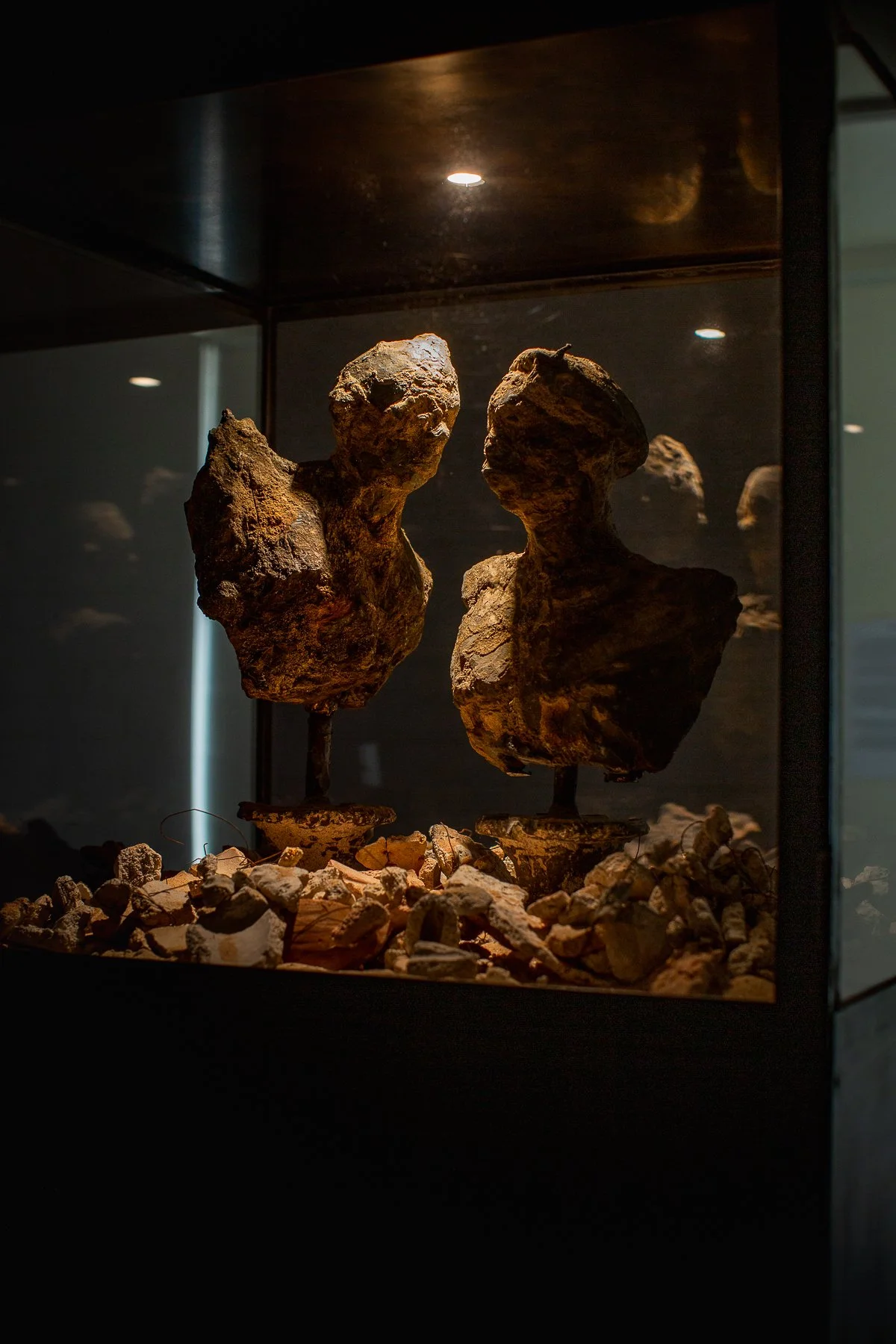
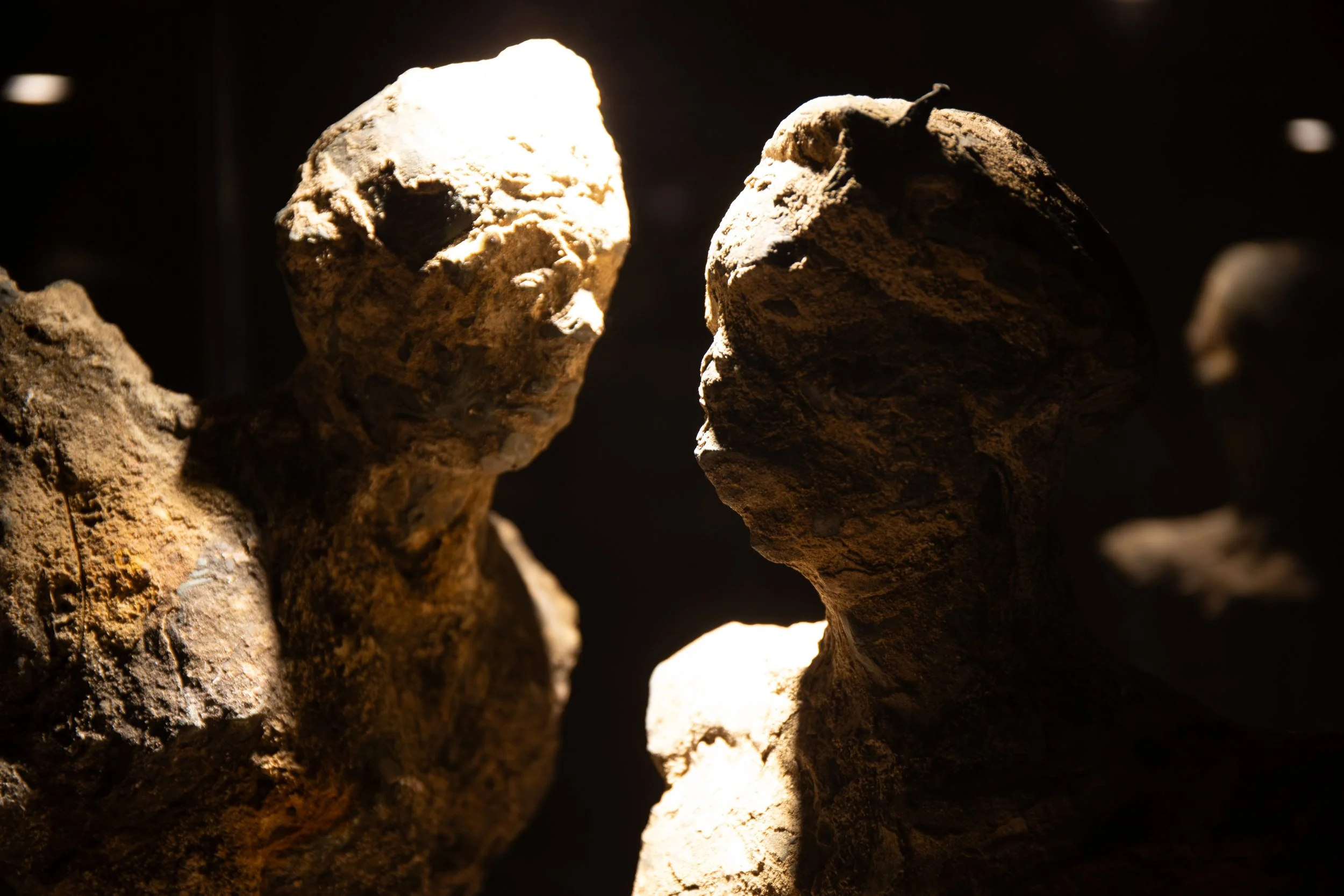
The Secret examines memory through partial exposure, material contact, and prolonged environmental transformation. Two bronze busts were produced using the lost-wax casting process and retained within sections of their ceramic shell moulds. The shells were only partially removed, leaving areas of the original mould in sustained contact with the cast bronze.
Following casting, the busts were left outdoors for approximately three years. During this period, environmental exposure produced uneven material change. Areas of exposed bronze developed deepened patination, while the ceramic shell surfaces became increasingly pitted as aggregate material emerged through erosion. In deeper recesses of the shell, organic growth developed over time, registering prolonged exposure and moisture retention.
After this period of exposure, each bust was mounted onto a bronze base incorporating a vertically cast rod. This intervention consolidated each work into a single structural unit. Despite this material unification, temporal discrepancy remains visible. Elements exposed to prolonged weathering register greater age and alteration than the newly cast supporting structures.
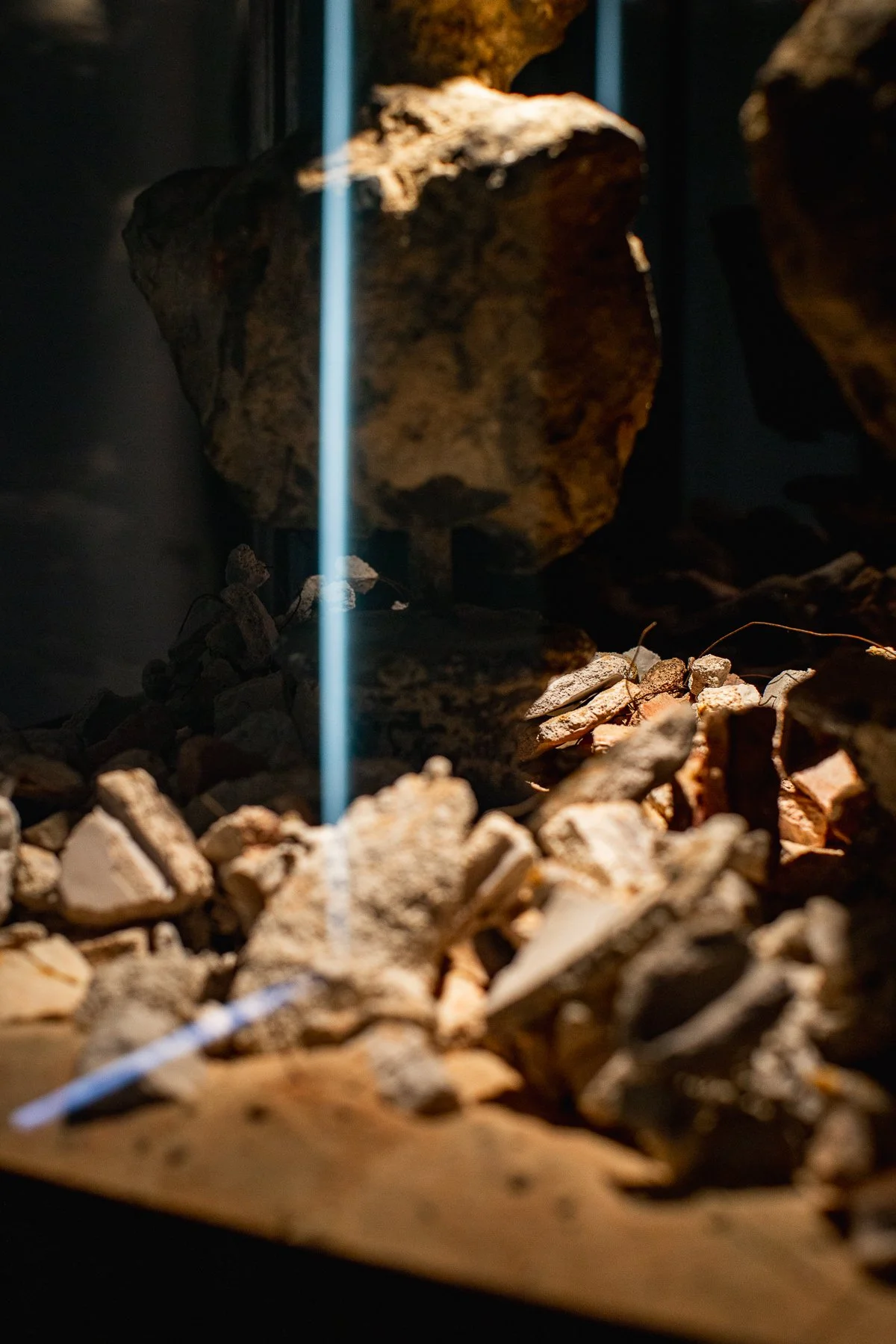
The two busts are presented together within an enclosed vitrine, accompanied by fragments of broken ceramic shell placed at the base. While the vitrine slows further environmental change, material transformation continues at a reduced pace. The remaining ceramic shell partially obscures the bronze forms and alters their original contours, producing a condition in which form is simultaneously revealed and withheld.
Through sustained contact between bronze and ceramic shell, the work foregrounds the empreinte as a material operation rather than a representational gesture. Memory is approached as a condition produced through contact, delay, and uneven persistence. What remains is shaped by exposure, concealment, and differential survival rather than by complete revelation or loss.
Images: Steven Vawdrey and Sabine Bannard